
Why the Last Group Game Is Different
How the table changes what teams are trying to do and what we can predict

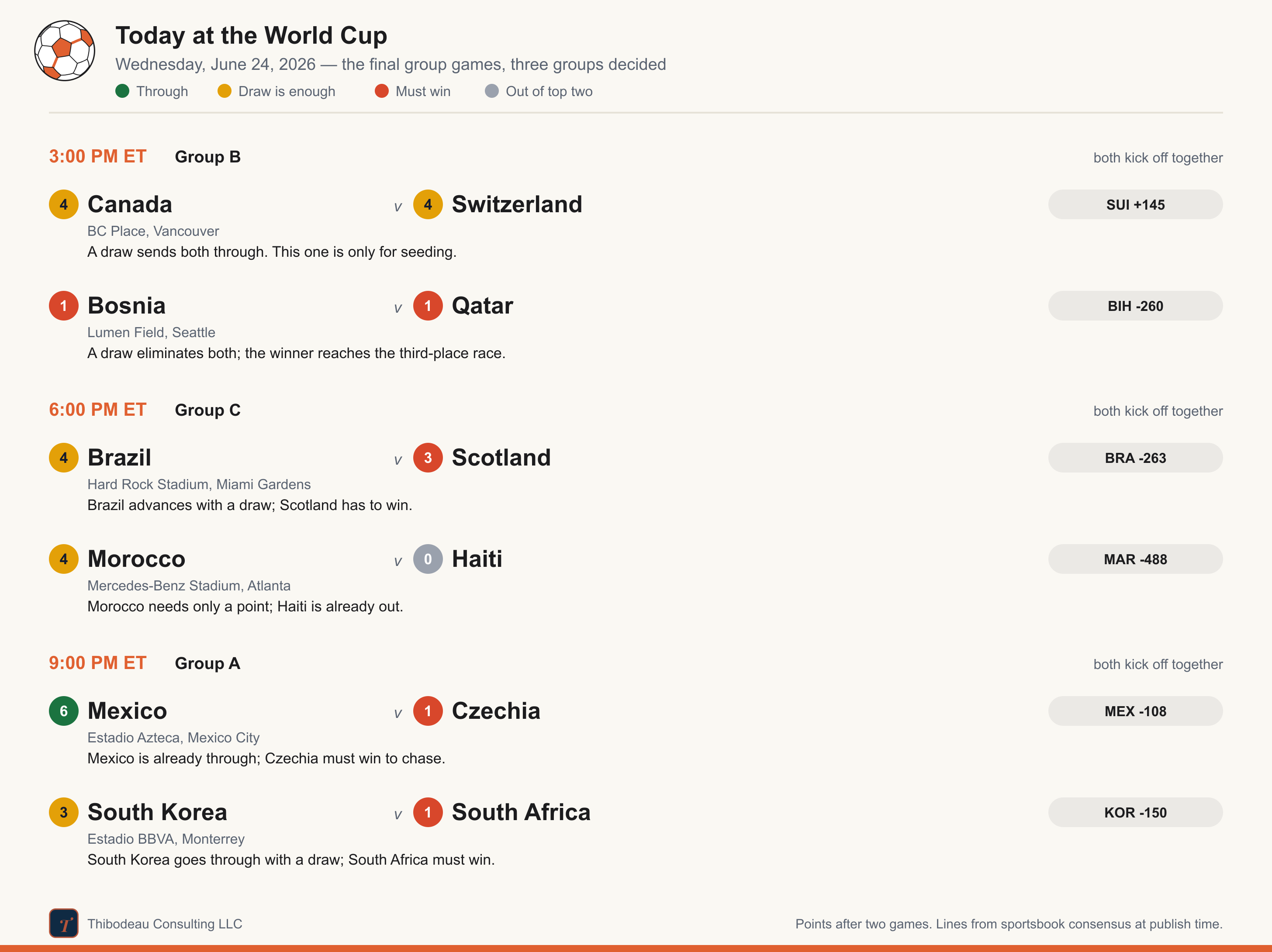
Day fourteen, and the distinction between “group stage” and “knockout round” starts to blur. From here on, the last two games in a group kick off at the same time, because the table is no longer just recording the tournament. It is steering it. Today we get six games, three groups closing at once, and the part of soccer where game theory stops being an academic phrase and starts deciding who chases, who waits, and who goes home. But first, a quick recap.
Previously, at the World Cup
Day thirteen belonged first to Cristiano Ronaldo, because of course it did. Portugal had opened the tournament with a flat 1-1 draw against DR Congo and needed a reset; Ronaldo supplied it, scoring twice in a 5-0 win over Uzbekistan and becoming the first man to score in six different World Cups. Colombia joined Portugal near the top of Group K with a 1-0 win over DR Congo, Daniel Muñoz finally breaking through after the Congolese had spent most of the night hanging on. In Group L, England ran into Ghana, who held them to a 0-0 draw in Foxborough, while Croatia kept itself alive and eliminated Panama with a 1-0 win in Toronto. For the models, that meant a mixed but mostly costly day for our Classic read: the Colombia lean paid, the Portugal and Croatia skepticism did not, and the England draw punished the whole board. The scoreboard updated accordingly.
Question 14: What happens when both teams can like the same score?
The most important match in World Cup rule-making history was not a classic. It was not beautiful or technically interesting. It was a game so cynical that it changed the schedule for good.
By the last day of their group in 1982, the standings were simple. Austria had four points, Algeria had four, West Germany had two, and Chile had none. (A win was worth two points back then, not three.) The twist was the schedule: Algeria and Chile were already done, while West Germany and Austria still had one game left, against each other. So the two teams about to take the field knew the exact target. A West Germany win by one or two goals would send both West Germany and Austria through, and Algeria out.
Ten minutes in, West Germany scored. At 1-0, the game changed. Not officially: the clock kept running, the ball stayed in play, and the referee had no rule he could point to and say, stop doing that. But the strategic problem had changed. The first ten minutes had been a soccer match. The next eighty were something stranger, two teams quietly sharing a result that suited them both.
The outrage outlived the match. FIFA’s fix was not to ask referees to judge effort; it was to change the information. Ever since, the last games in each group have kicked off at the same time, so no team can walk onto the field already knowing the exact bargain that sends both sides through.
That is an incentive patch, not a virtue patch. It does not make players more honest. It makes coordination harder. If both matches are unfolding together, you cannot step out with the completed table in your pocket. You can hear crowd noise. You can react to live information. But the clean, precomputed bargain is gone.
The scoreboard is part of the game
We usually talk about incentives as if they live inside people. This team has heart. That team has quit. This manager is brave. That one is cynical. But in a tournament, incentives also live in the table. They live in the order of games, the tiebreakers, the number of teams that advance, and whether one team knows another team’s result before it plays.
Gijon is a clean example. Nothing about the players’ talent changed after the opening goal. The ball did not get heavier. Austria did not forget how to attack. West Germany did not forget how to score a second. What changed was the payoff matrix.
Before the goal, West Germany needed to score. After the goal, West Germany needed the score not to move too much. Austria, meanwhile, needed exactly the same thing. A second German goal was tolerable. A third made the math more dangerous. An Austrian equalizer sent West Germany out. The safe strategy for both sides was caution, possession, and time. So caution, possession, and time is what the match got.
The scoreboard is also a forecast
There is a second, quieter way the table takes over, and it shows up not on the field but in the forecast. Before a tournament, predicting who advances is hard work: you weigh ratings built from years of results, market prices, form, injuries. Two games in, the single most useful thing you can know about a team is its position in the standings.
Take every group stage from the last seven World Cups and try to predict which teams advance. A forecast built on pure team strength lands at a Brier score of 0.211, where 0.250 is the score of knowing nothing at all. Remember that a lower Brier means better predictions. Useful, and about as well as you can expect to do before any games kick off. Then let two games happen and add the table: points, goal difference, and who each team has left. The error nearly halves, to 0.116.
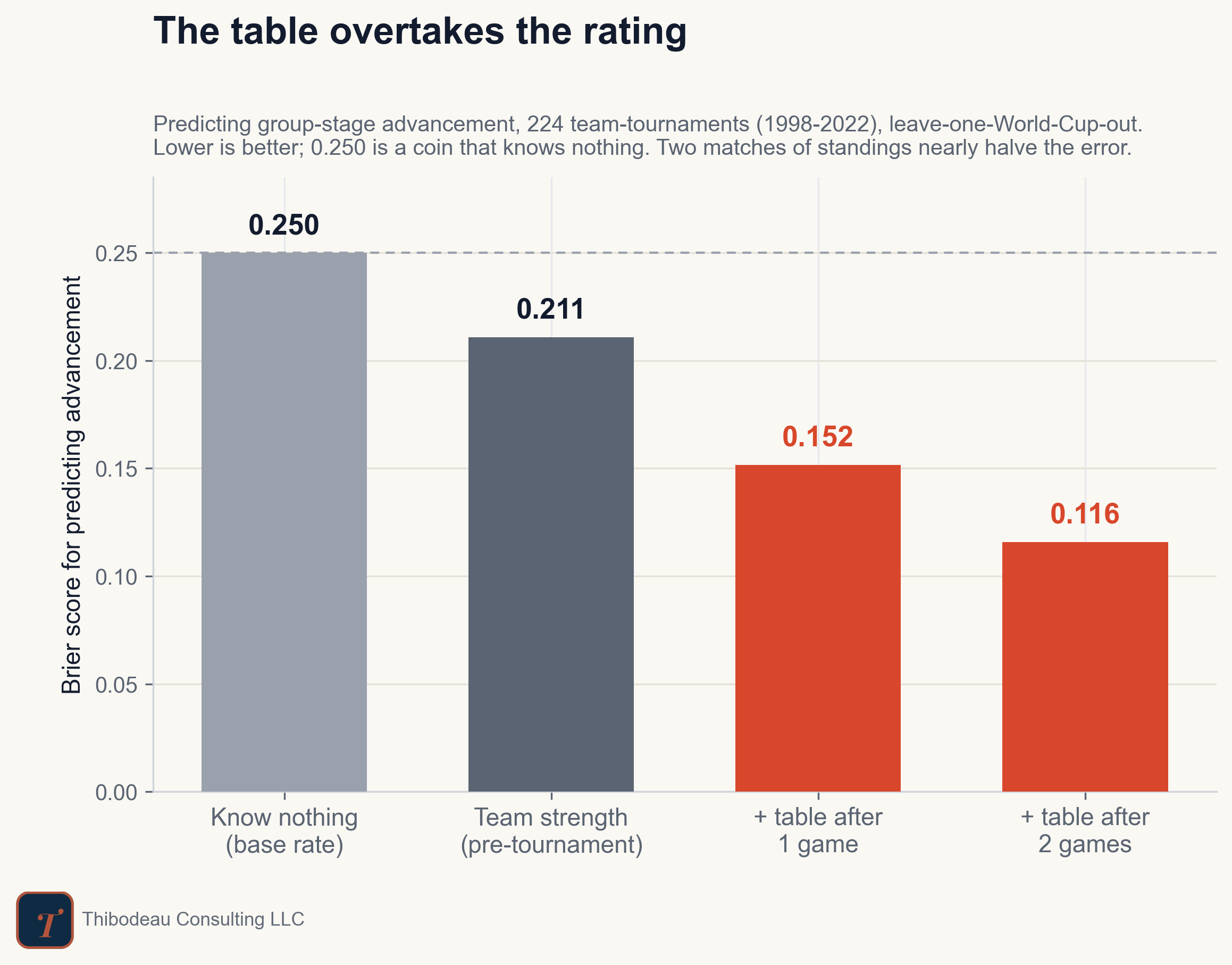
The tempting name for that jump is momentum, the idea that hot teams stay hot. But that’s not the right way to think about it. In this case, the jump is mostly arithmetic. The first two games do not reveal a hidden spirit; they rewrite the standings, and the standings are most of what is left to predict. A team that has won twice is not riding a wave. It has six points, and in seven World Cups a team with six points after two games has advanced every time.
Here is the whole staircase. After two games, zero points has advanced zero percent of the time, one point fourteen, two points sixty-nine, three points forty-four, four points eighty-five, and six points always.
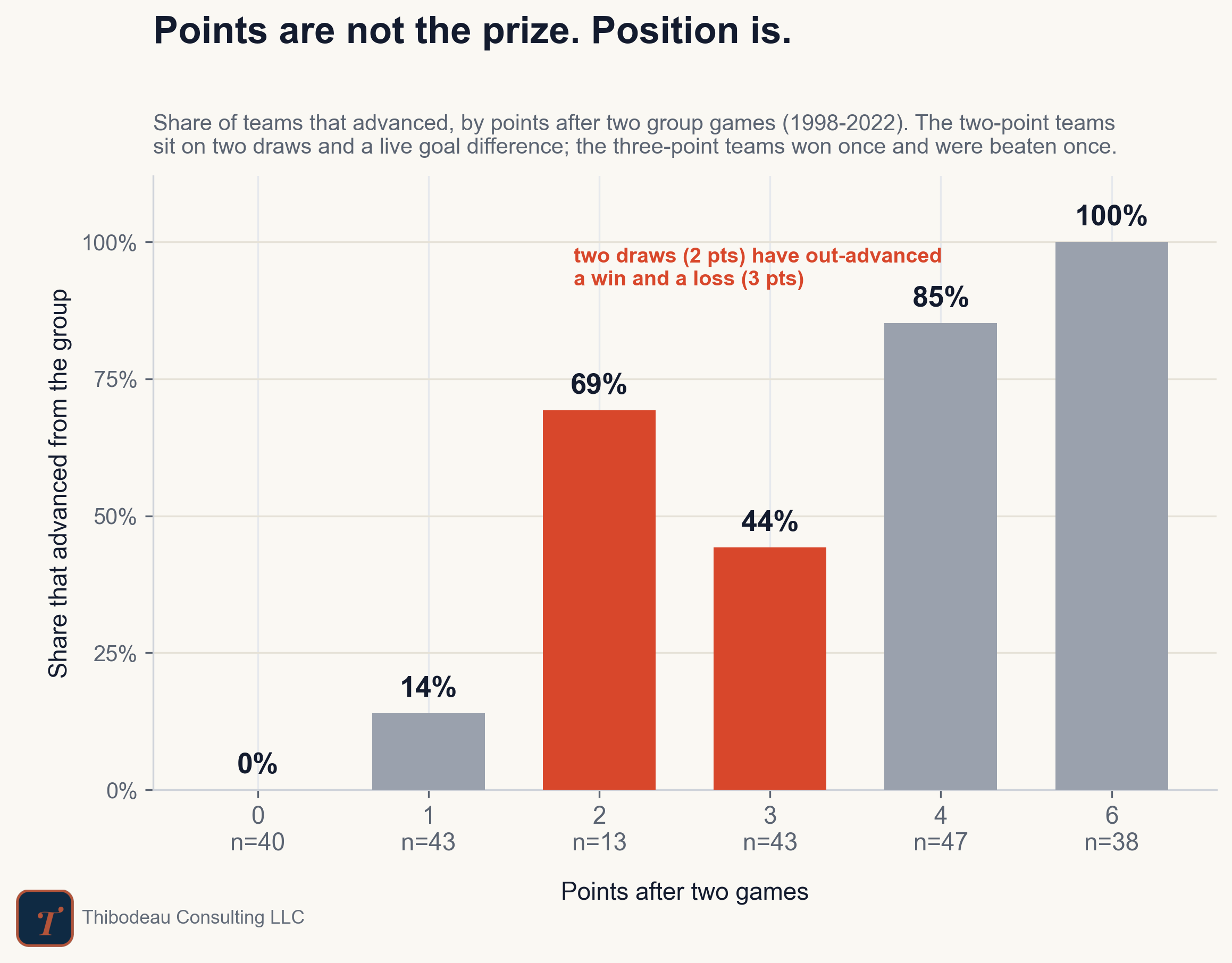
You might notice a step in the wrong place. Two points has advanced more often than three. A team that drew both its openers has done better than a team that won one and lost one, even though the second team has an extra point. The two-point group is small, only thirteen teams, so hold the exact figure loosely.
But the mechanism makes soccer sense. Points are not the prize. Position is. Two draws usually means two close games and a goal difference still alive; a win and a loss often means one good night, one bad one, goal-difference damage, and a last game you no longer fully control.
Which is where the two halves of this post meet. By the third game, the table has done something a pre-tournament rating never could: it has turned the same fixture into two different problems for the two teams playing it. One needs a win. The other needs only to avoid losing. That is not a fact about talent, and it is not momentum. It is the scoreboard handing each side a different assignment, the same force that emptied the last 80 minutes in Gijon, now showing up in who can afford a draw and who has to chase.
This year, the math is looser
Everything above came from the old shape of the tournament: thirty-two teams, eight groups, top two and out. The math was strict and the bargains were exact. A 1-0 was enough or it was not.
2026 changes the shape. Forty-eight teams, twelve groups of four, and the part that matters most for this story: the top two in each group go through, and so do the eight best third-place teams. Thirty-two of forty-eight advance, two in three, where the old format sent home half the field. Third place is no longer a death sentence. It is often a lifeline.
That cuts two ways.
First, “good enough” arrives more often. When third place can survive, more teams reach the final day holding a result they can live with, and more final games carry the Gijon temptation instead of a clean must-win fight. The simultaneous kickoff was built for a smaller, stricter tournament. In a field this forgiving, it matters more, not less.
Second, the bargain is harder to compute. In Gijon the table was closed: Algeria and Chile were done, the target was a fixed number, and two teams could read it before kickoff. A third-place chase is open. Whether four points, or three with a decent goal difference, is enough depends on eleven other groups, some still playing. A team can want a draw and still not know, at kickoff, whether the draw is enough. The clean precomputed bargain becomes a bet.
And it bends the forecast too. Remember that the numbers above come from the fifty-percent-advance era; this is a sixty-seven-percent one. The shape of the lesson holds, but the exact thresholds for “enough” have moved. We are grading a model on a world it did not grow up in, which is its own kind of test. We’ll have the verdict on Sunday.
Up Next
Tomorrow, we stay with the table, but move from groups to thresholds. The new format has created a third-place lottery: twelve teams can finish third, eight survive, and the line between safe and stranded probably comes down to goal difference.
Then, once the group stage is complete, we turn the lens on ourselves and the other forecasting models. Every pick this series has made is on the record. A full group stage is finally enough to ask the questions: where did the model miss, were those misses bad luck or bad assumptions, and did the table teach us something our ratings could not see?
Today’s Scorecard and Forecasts
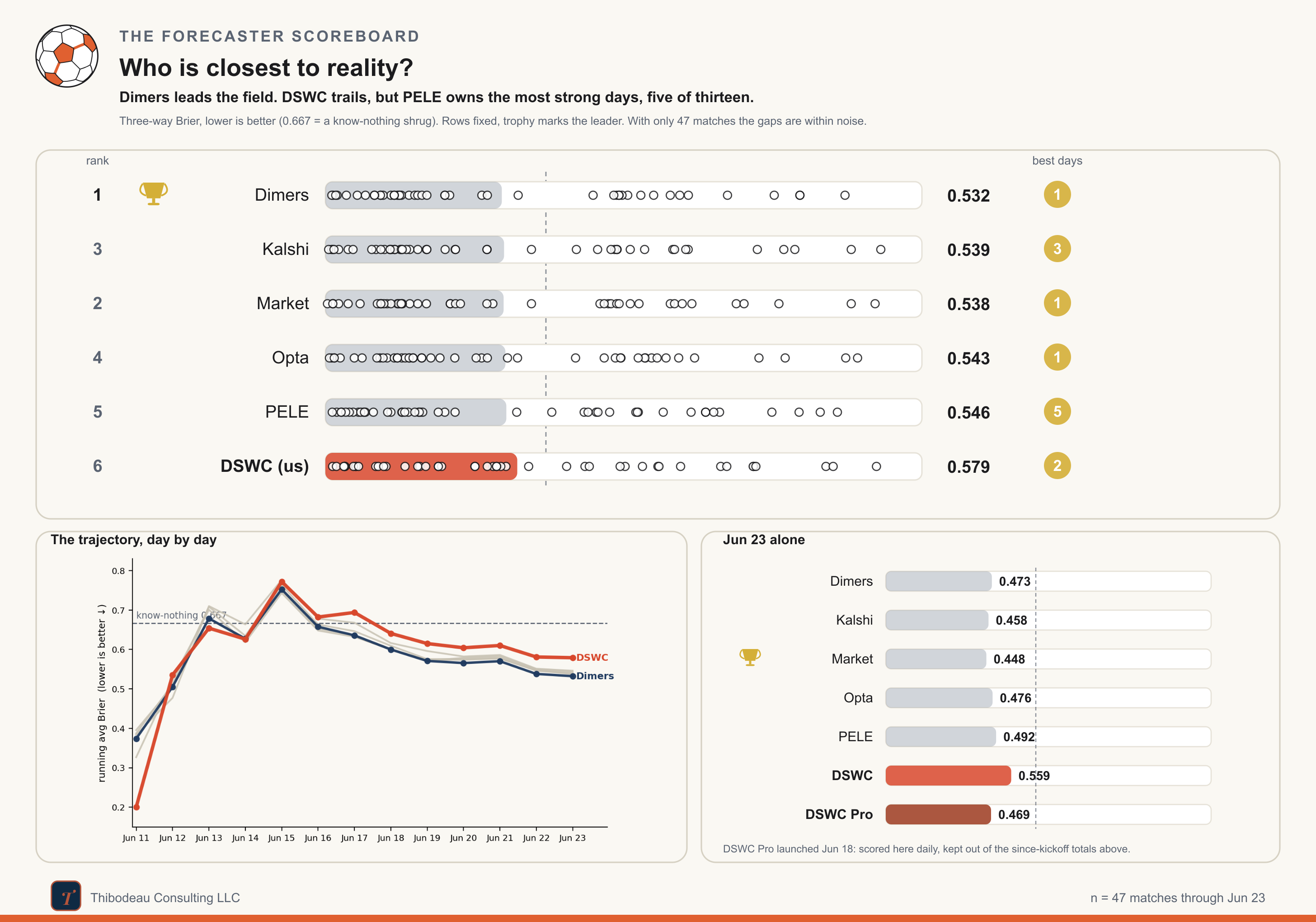
Day thirteen was not a table-shaker, but it did sharpen the shape of the scoreboard. The market had the best day at 0.448, with Kalshi, Dimers, Opta, PELE, and DSWC Pro all clustered behind it. Our Classic model finished last on the slate at 0.559, mostly because it was too skeptical of Portugal and Croatia and too confident in England.
The cumulative board still says what it has said for most of the week: Dimers leads, the market pack is tightly bunched. But the gap is still small enough to treat with caution rather than drama. Dimers sits at 0.532, the market, Kalshi, Opta, and PELE run from 0.538 to 0.546, and DSWC is at 0.579. That is last, but not broken. It is the cost of a model that takes lonely positions. Some of those have paid; yesterday, most did not.
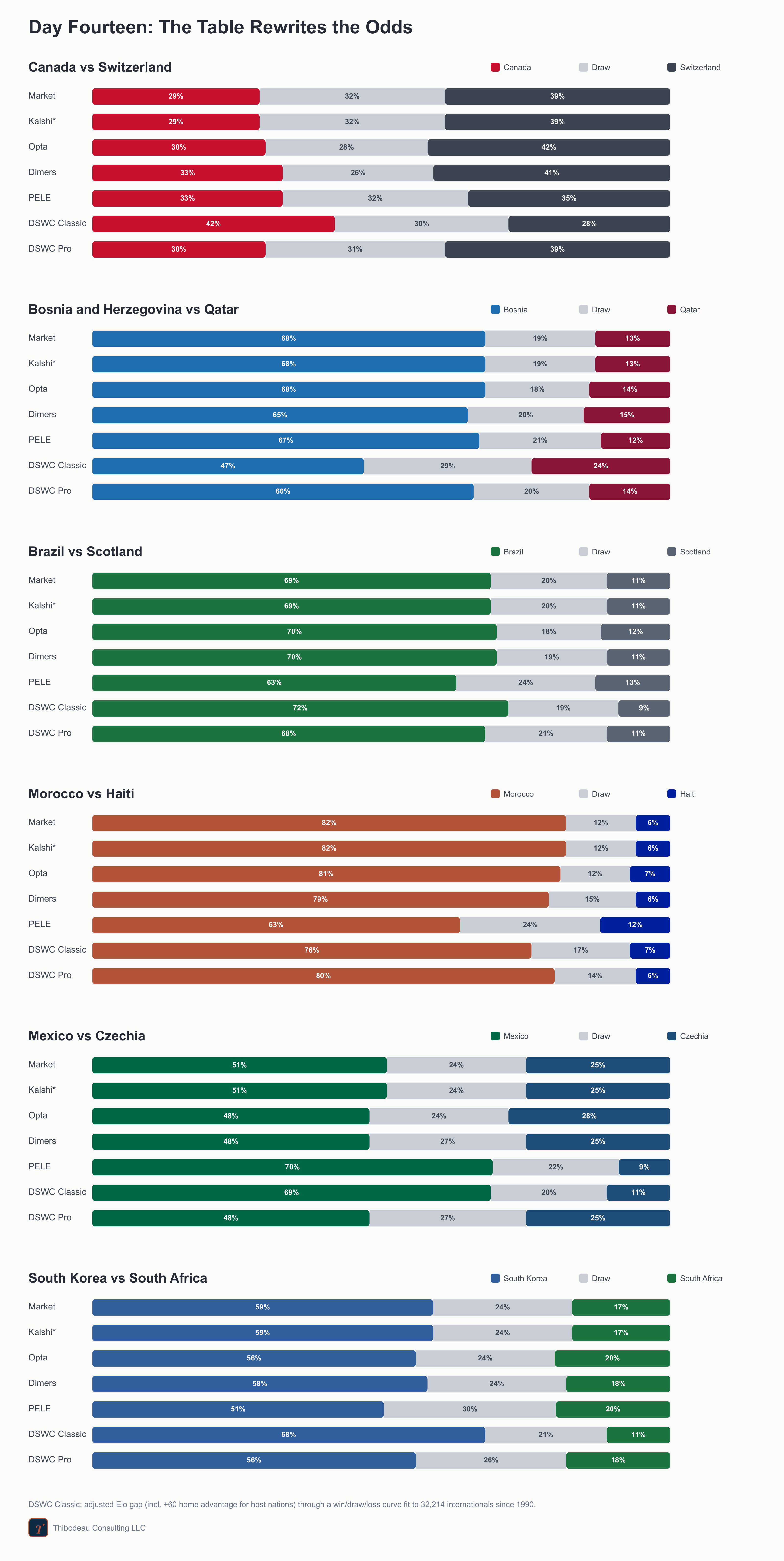
The forecast card for today is the essay in miniature: the table is rewriting the odds.
Canada-Switzerland is the cleanest example. The market makes Switzerland a slight favorite, 39 to 29, with the draw sitting way up at 32. That is not just team strength. That is the table talking: both teams are on four points, and a draw sends both through. Our Classic model, which sees ratings but not incentives, makes Canada the favorite at 42 and still leaves the draw at 30. Pro pulls back to the field.
The opposite game is Bosnia-Qatar. Both are on one point, so a draw does almost nothing. The field makes Bosnia a clear favorite around 65 to 68, while Classic is much cooler at 47 and gives Qatar 24. That is the same old Classic problem: it sees a narrower Elo gap than the market sees in the squads. Pro again sides with the crowd.
The other loud splits are Mexico-Czechia and South Korea-South Africa. Classic and PELE are much higher on Mexico than the market is, near 70 instead of roughly 50, even though Mexico is already through and may not need to chase the game. Classic is also high on South Korea, 68 where the field sits closer to the high 50s. Those are the places to watch today: not just who is better, but who actually needs the result.
Also love this piece of game theory history:
https://en.wikipedia.org/wiki/Barbados_4%E2%80%932_Grenada
“On January 27, 1994, the national football teams of Barbados and Grenada played against each other as part of the qualification round for the 1994 Caribbean Cup. Barbados won 4–2 in extra time. In the last minutes of regular time, both teams attempted to score own goals. The result has been described as "one of the strangest matches ever".[1][2]
“In the 1994 Caribbean Cup, the tournament organisers implemented a variant of the golden goal rule: the first goal scored in extra-time not only won the match, but was also worth two goals. Barbados needed to win the match by a margin of at least two goals to qualify for the final over Grenada. Barbados led the game 2–0 until Grenada scored in the 83rd minute, bringing the score to 2–1. Barbados then deliberately scored an own goal, tying the game at 2–2, to force extra-time so that they could take advantage of the golden goal rule to achieve their needed two-goal margin.[1]
This resulted in an unusual situation where Grenada tried to score in both goals for the last three minutes of regular time. Either outcome (3–2 on points, or 2–3 via goal difference) would have advanced them to the finals, while Barbados had to defend both goals. Ultimately, Barbados was able to prevent Grenada from scoring, forcing extra-time. Barbados then scored the golden goal to win the match