Quarterfinal Preview: Everyone Left Is Good
The favorites win less here than anywhere else, and penalties loom large

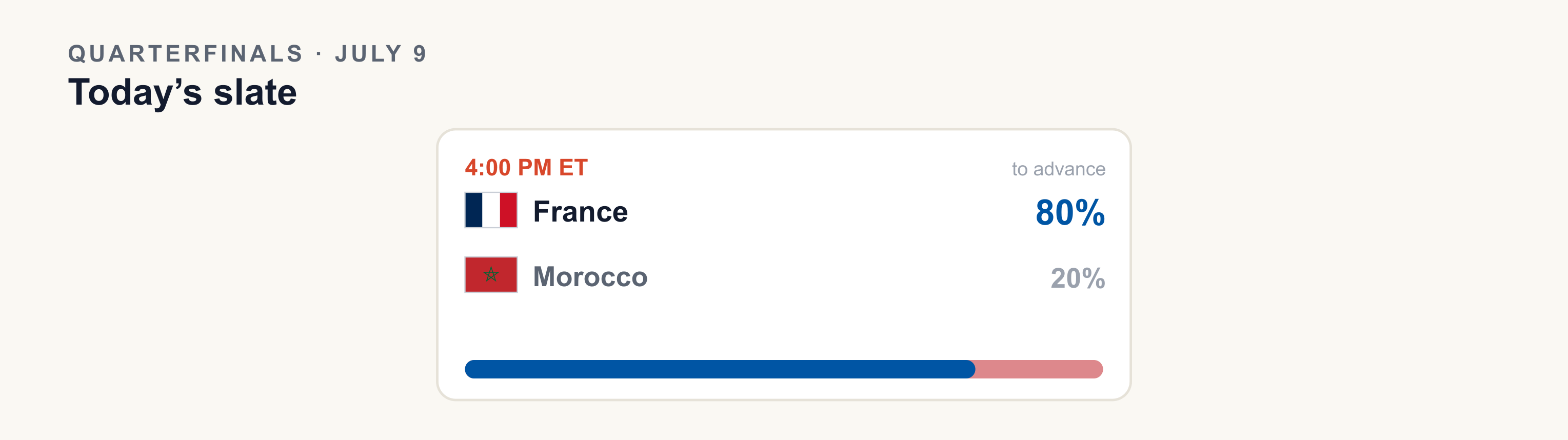
Day 29, and the quarterfinals have arrived: eight teams left, all of them good, none of them safe. The round begins with France against Morocco, a replay of a 2022 semifinal. France won that night, 2-0, but not in a favorite-rolls-underdog kind of way. Morocco had 61 percent of the ball and matched France with three shots on goal. They were out-finished but not out-played. That is the memory Morocco bring into today. We’ll see if they can turn it into a different result later this afternoon.
There were no games yesterday, so no recap today. Instead, two quick things before we get to an analysis of what tends to change at this stage in the tournament.
One Question For You
First, I’m starting to think about what this project becomes after the World Cup ends. If you’ve been following along, I want to know what’s kept you reading. And if you have more to say about the project or suggestions for what comes next, I’d love to hear from you in the comments or by email (paul@consult-thib.com).
A World Cup Dashboard
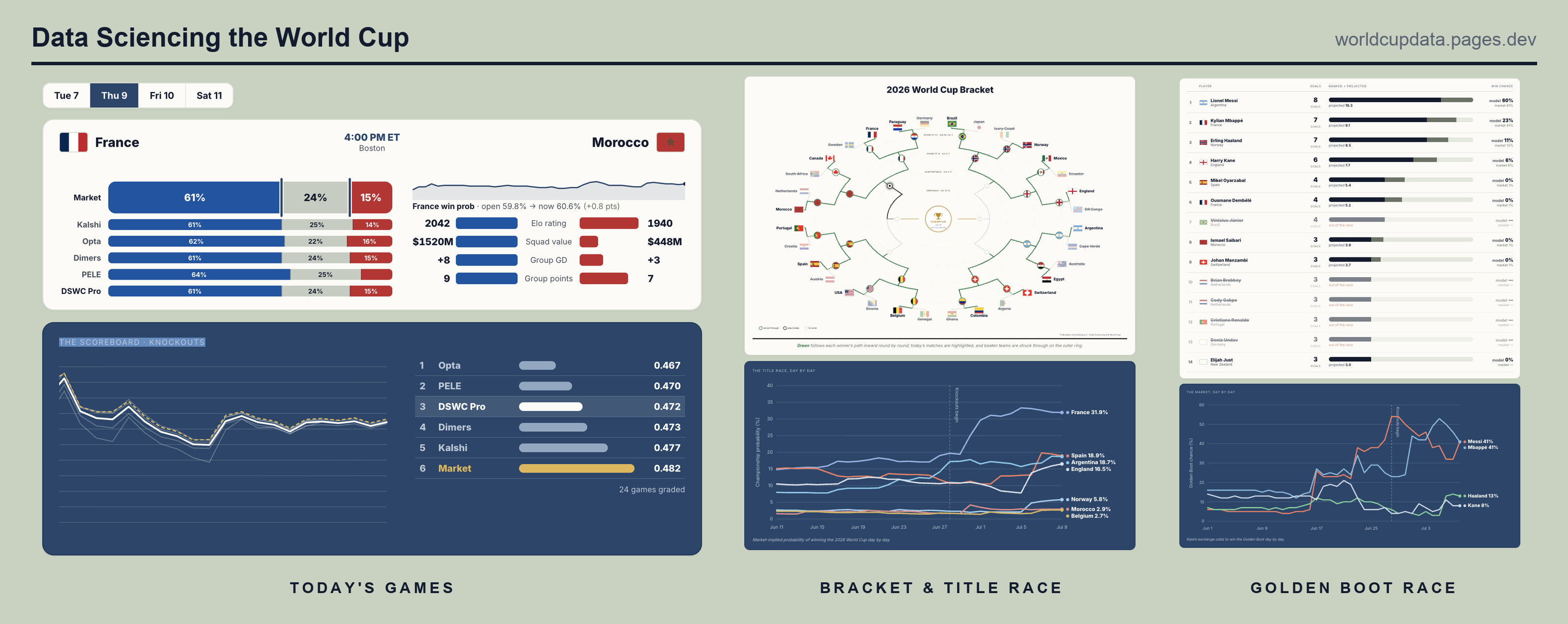
Second, I built a small website to help us follow the rest of the tournament: worldcupdata.pages.dev. It shows today’s games with the full forecaster field, the live bracket, and the scoring race.
Dashboarding is a bigger part of data science work than people sometimes realize. Not every useful data product is a model or analysis. Often, the job is to make existing data more available and accessible.
So consider this a small dashboard lesson too. Good dashboards are not encyclopedias. They answer the questions people keep asking, in the moment they need the answer. For this tournament, I focused on three: who is favored today, what the bracket looks like now, and who is leading the Golden Boot race.
Question 29: What changes in the quarterfinals?
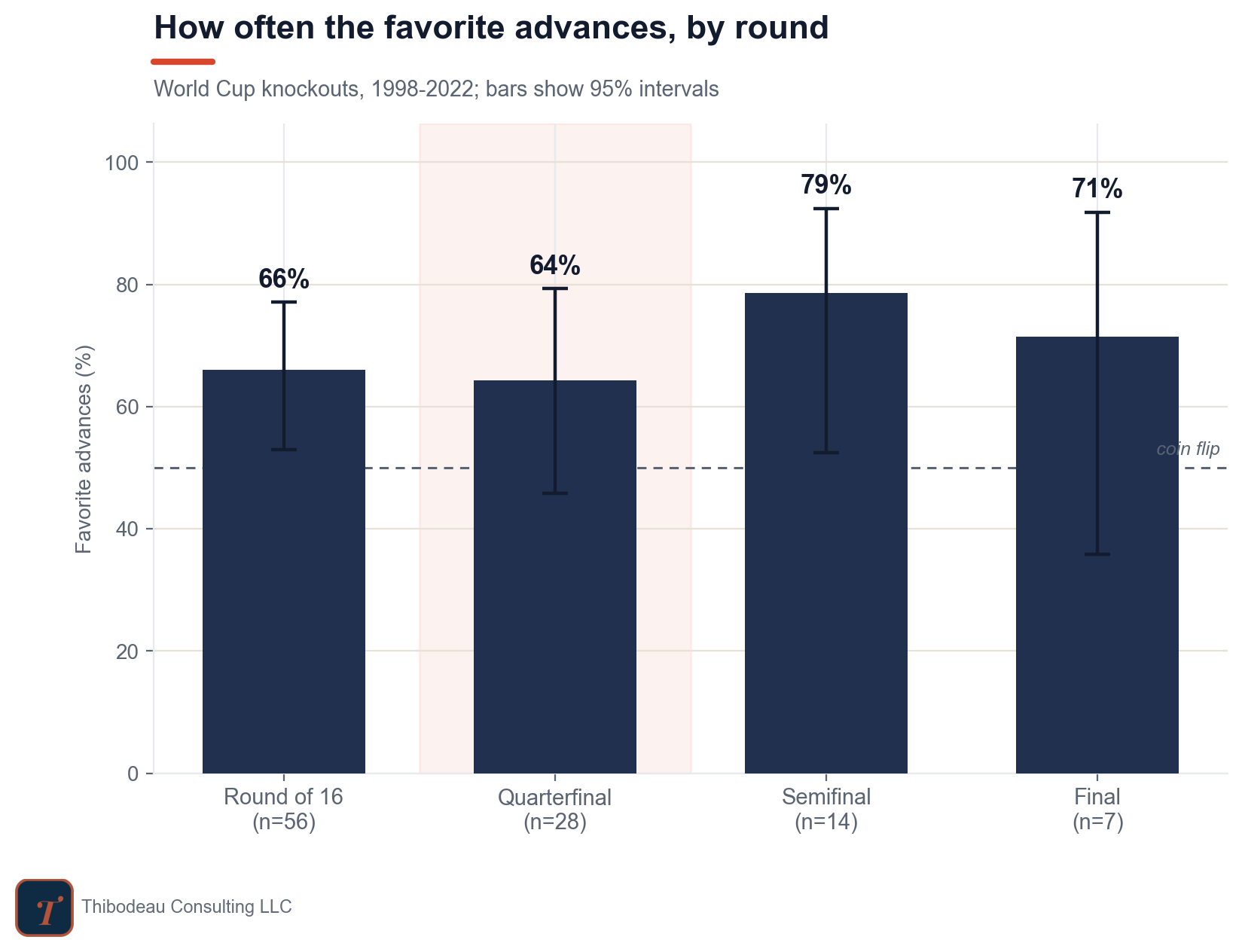
By the time a World Cup reaches eight teams, the bracket feels different. The easy outs are gone. The underdogs are no longer just happy to be there. The favorites are still favorites, but they are now running into teams that have already survived pressure and solved a knockout game.
So the question is not just whether the teams are better. Of course they are. The question is what changes about the games. Do the gaps between teams actually shrink? Do favorites still capitalize on their edge? Do early goals settle things, or do matches keep dragging themselves back toward danger?
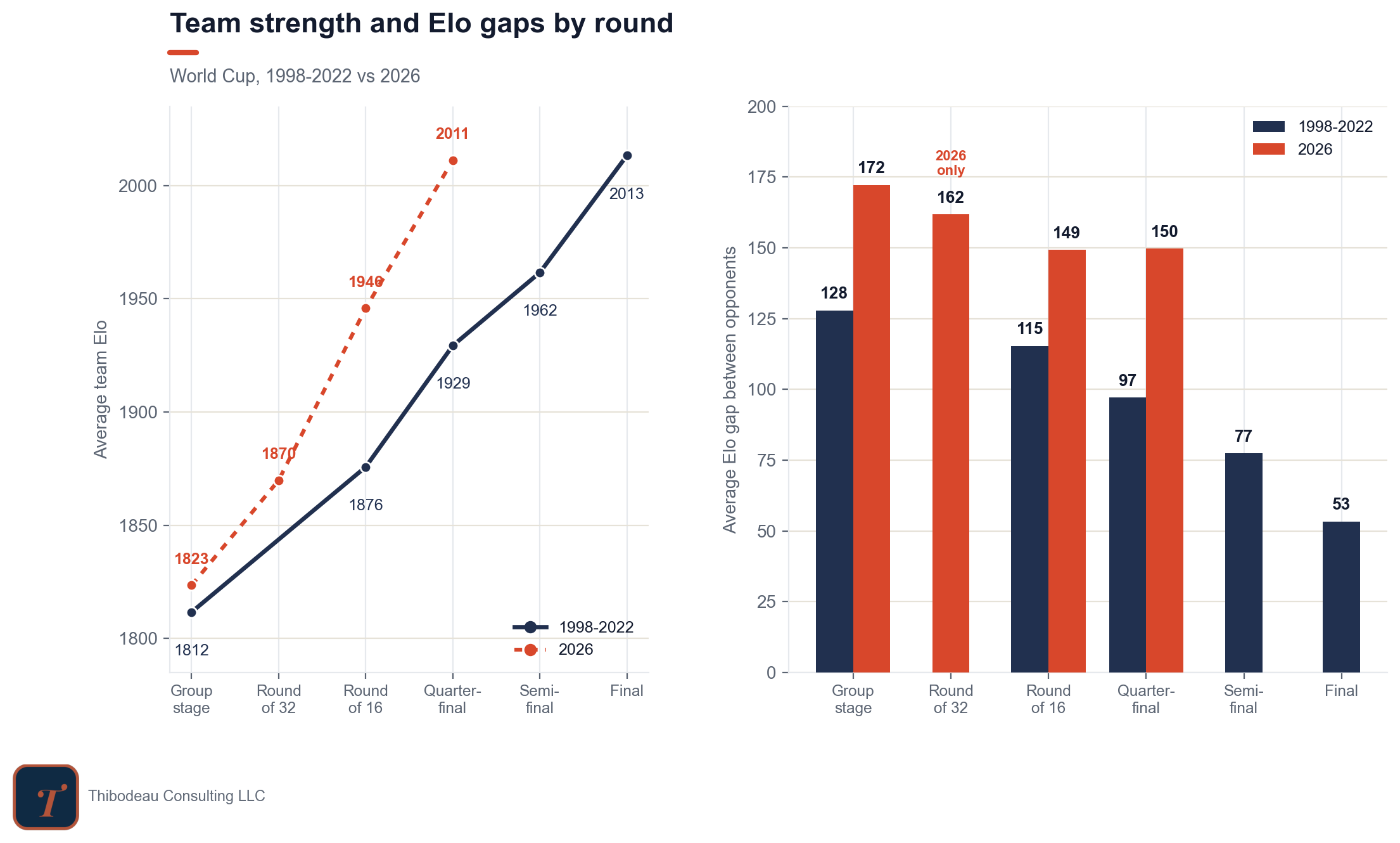
Let’s start with the basic shape of the bracket: as the tournament advances, the teams get better and the matchups tighten. Elo is our shorthand for team quality, built from match results, and the workhorse rating we’ve been using all tournament. By that measure, World Cups usually compress as they go. From 1998 through 2022, the average strength gap between opponents fell from 128 points in the group stage to 115 in the Round of 16, 97 in the quarterfinals, 77 in the semifinals, and 53 in the final. The deeper you go, the fewer mismatches remain.
This year looks similar, but not identical. The expanded field gave us bigger gaps early, and the quarterfinals still look unusually spread out: an average gap of 150 Elo points, compared with a historical quarterfinal average of 97. The field has tightened, but not as much as it usually does.
So compression is part of the story. But if the only thing happening were that “the teams get closer,” the quarterfinals would be interesting but not especially strange. In fact, when we look closely, we can see that the games themselves also change.
Since 1986, the quarterfinal has been the lowest-scoring round of the World Cup: 2.17 goals per game, which is below the group stage, the Round of 16, the semifinal, and the final. It has also had the smallest average winning margin, just 0.88 goals per game.
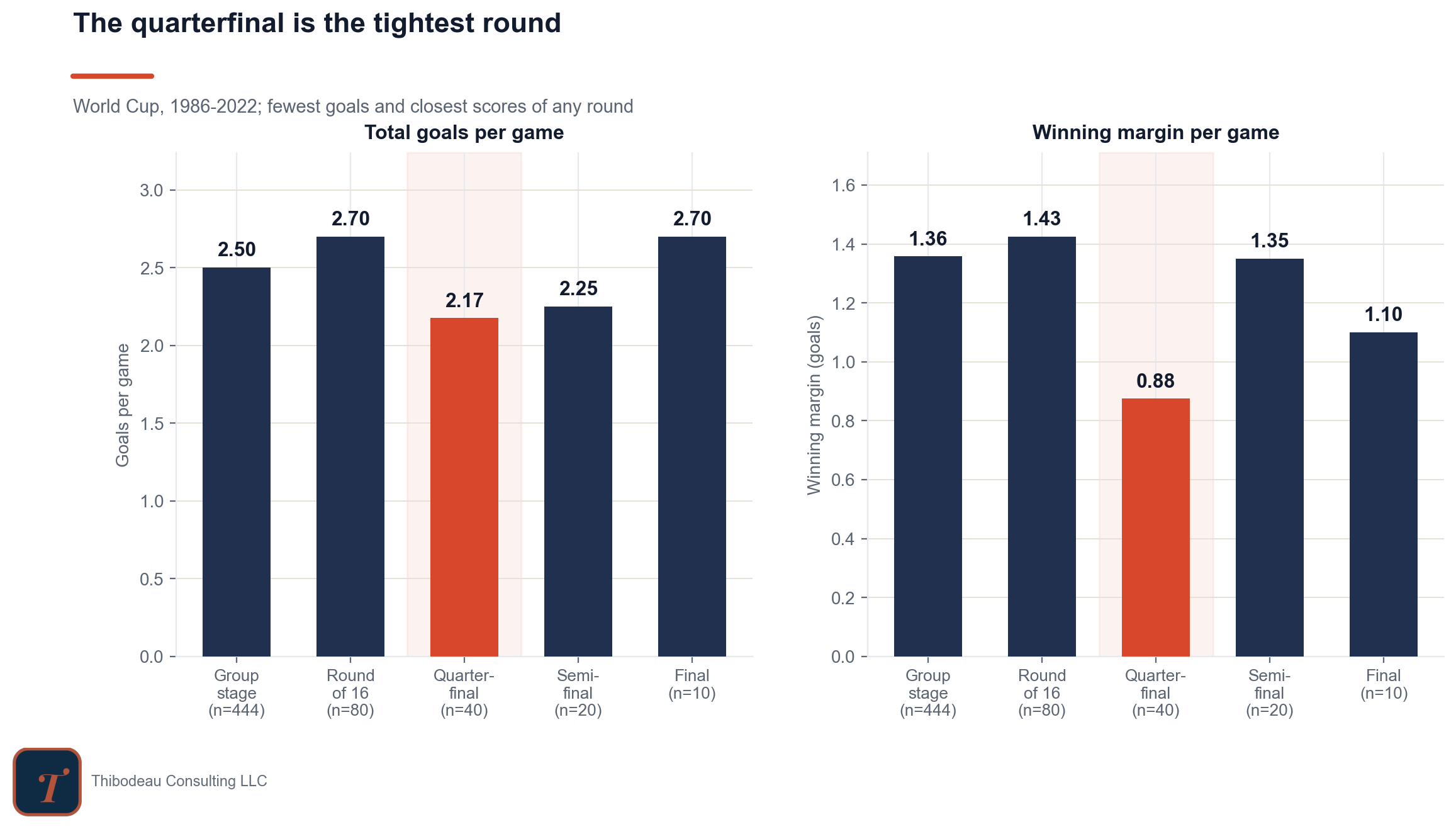
What’s surprising here is that the chaos does not rise smoothly as the tournament gets deeper. The semifinal has actually been calmer: favorites win more often and by a larger margin, on average. The quarterfinals have been the bigger bottleneck. The caveat, of course, is sample size. There just haven’t been that many World Cup semifinals and finals.
The game gets longer
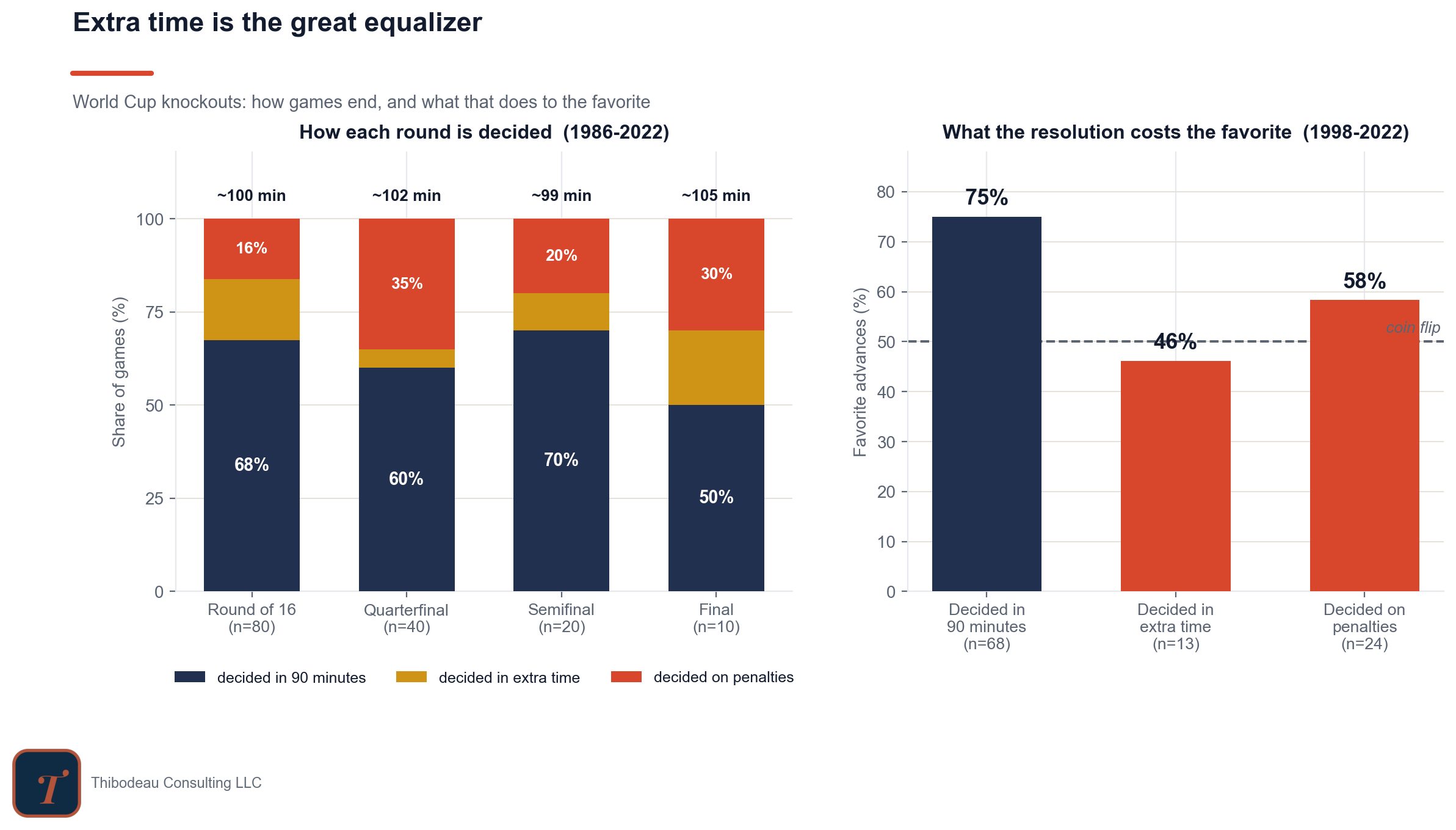
There is a specific way favorites tend to lose control in the quarterfinals: they run out of time. Across knockout history, favorites are much more reliable when the match is decided in regulation. Once a game reaches extra time or penalties, the data suggests that their edge disappears. That is partly mechanical. If the favorite were really in control, it probably would have won already. But it is also the emotional truth of the round. The longer the underdog survives, the more the match changes.
A favorite wants the game to stay ordinary: score first, manage the ball, get out in 90 minutes. An underdog wants the opposite: shorten the game, keep it level, and get the match to a penalty shootout. That is why penalties loom so large here. They are not just a tiebreaker. They are often the end state of the underdog’s best plan.
The first goal does sess settling
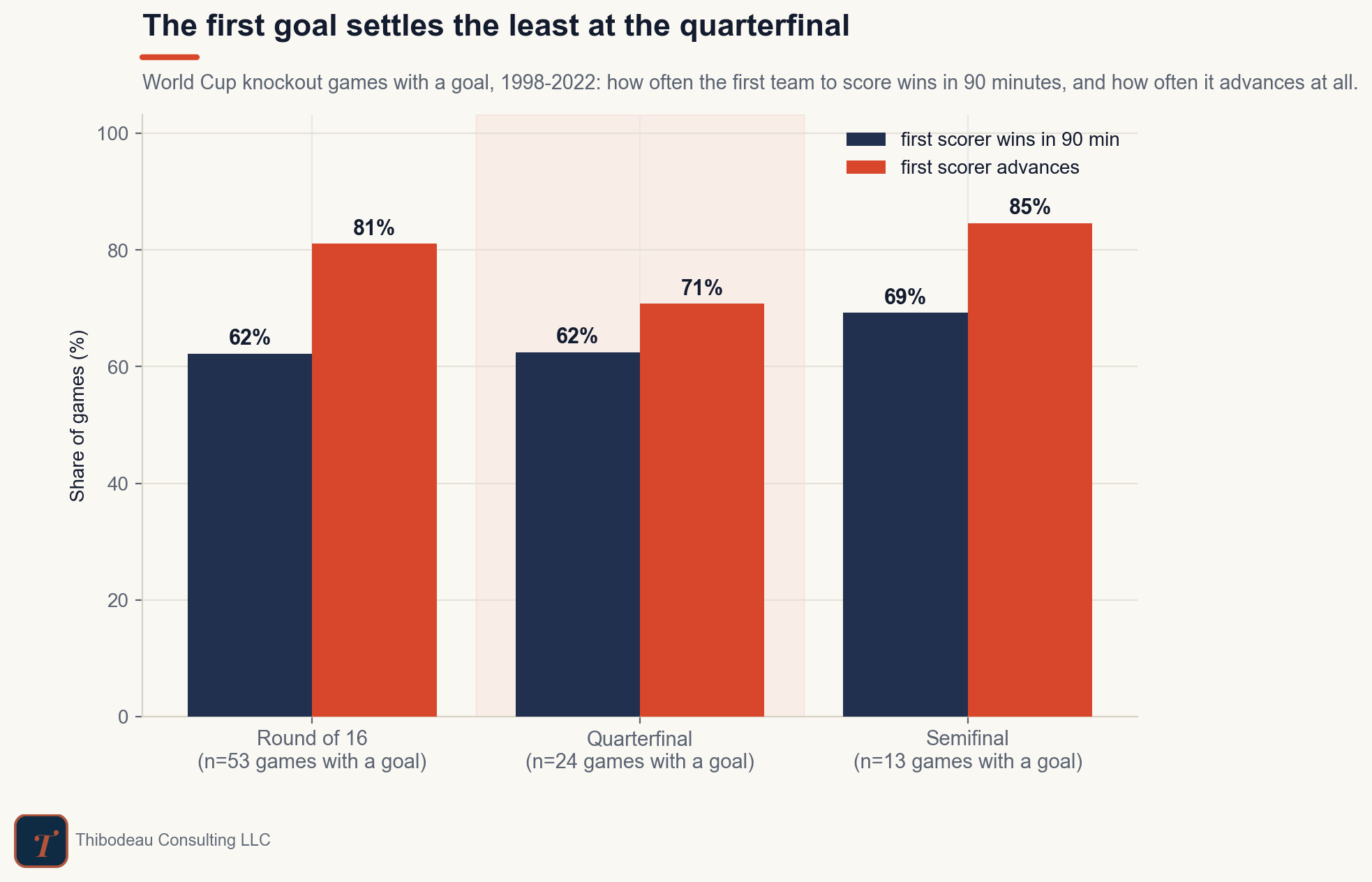
There is another way to see the quarterfinal squeeze: look at what happens after the first goal. Usually, scoring first in a knockout game is a huge deal. In the Round of 16 from 1998 through 2022, the team that scored first advanced 81 percent of the time; in the semifinals, it was 85 percent. The first goal does not end the game, but it usually puts the scorer control.
The quarterfinals are different. The first goal still matters, but less so. From 1998 through 2022, teams that scored first in a quarterfinal advanced 17 of 24 times, or 71 percent. This is not a claim to bet the house on; the samples are small, and the difference is descriptive rather than statistically clean. But it fits the broader quarterfinal profile: the first punch lands, but the game keeps fighting back.
We’ll find out soon if 2026 stays true to that pattern, or if this year’s wider gaps let the favorites breathe a little easier.
Today’s Forecasts
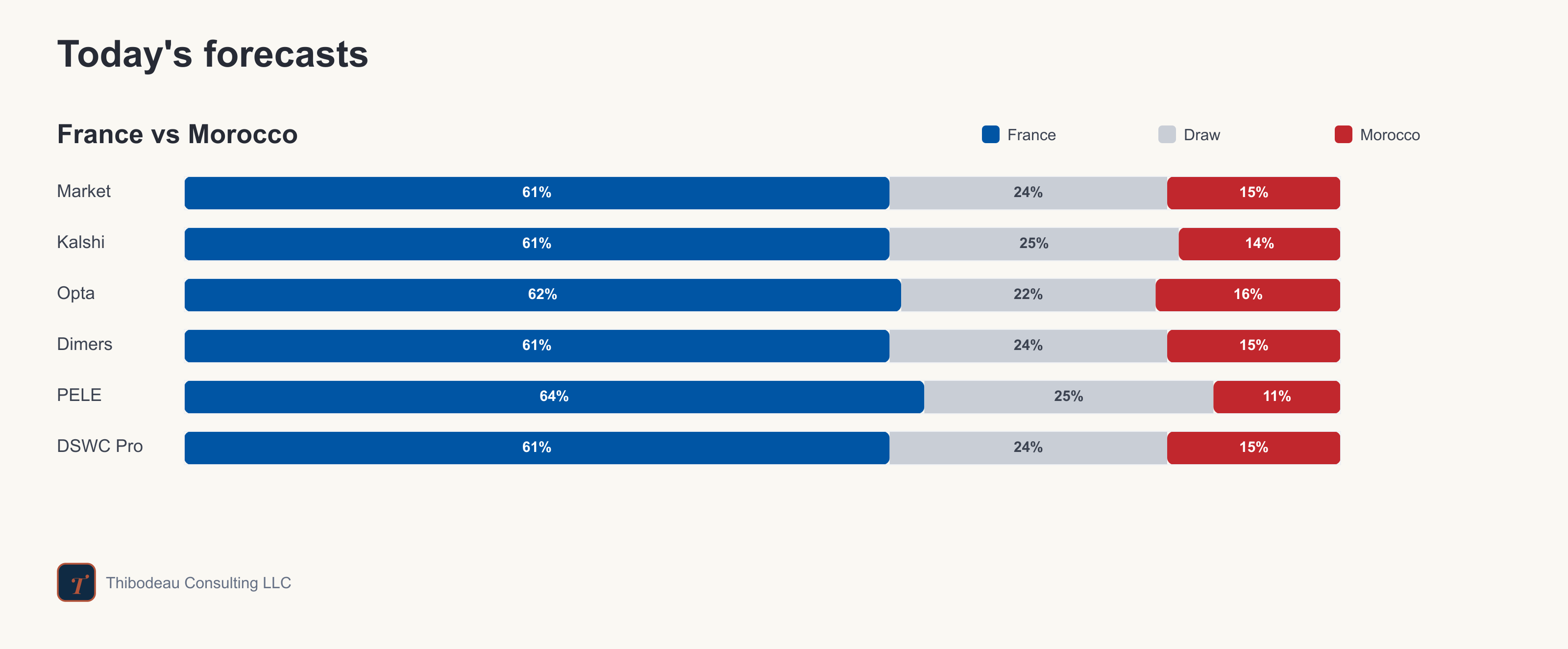
The forecasters mostly agree on France-Morocco. The market has France at 61 percent in 90 minutes, with a 24 percent draw and Morocco at 15. Kalshi, Dimers, and DSWC Pro land almost exactly there. Opta is a touch higher on France at 62 percent. PELE is the most confident, giving France 64 percent and Morocco only 11. So the consensus is clear: France should win, but this is not a blowout forecast. Roughly four times in ten, the game is either level after 90 or Morocco wins outright.