Why champions fall back to earth
Regression to the mean and the danger of tiny samples

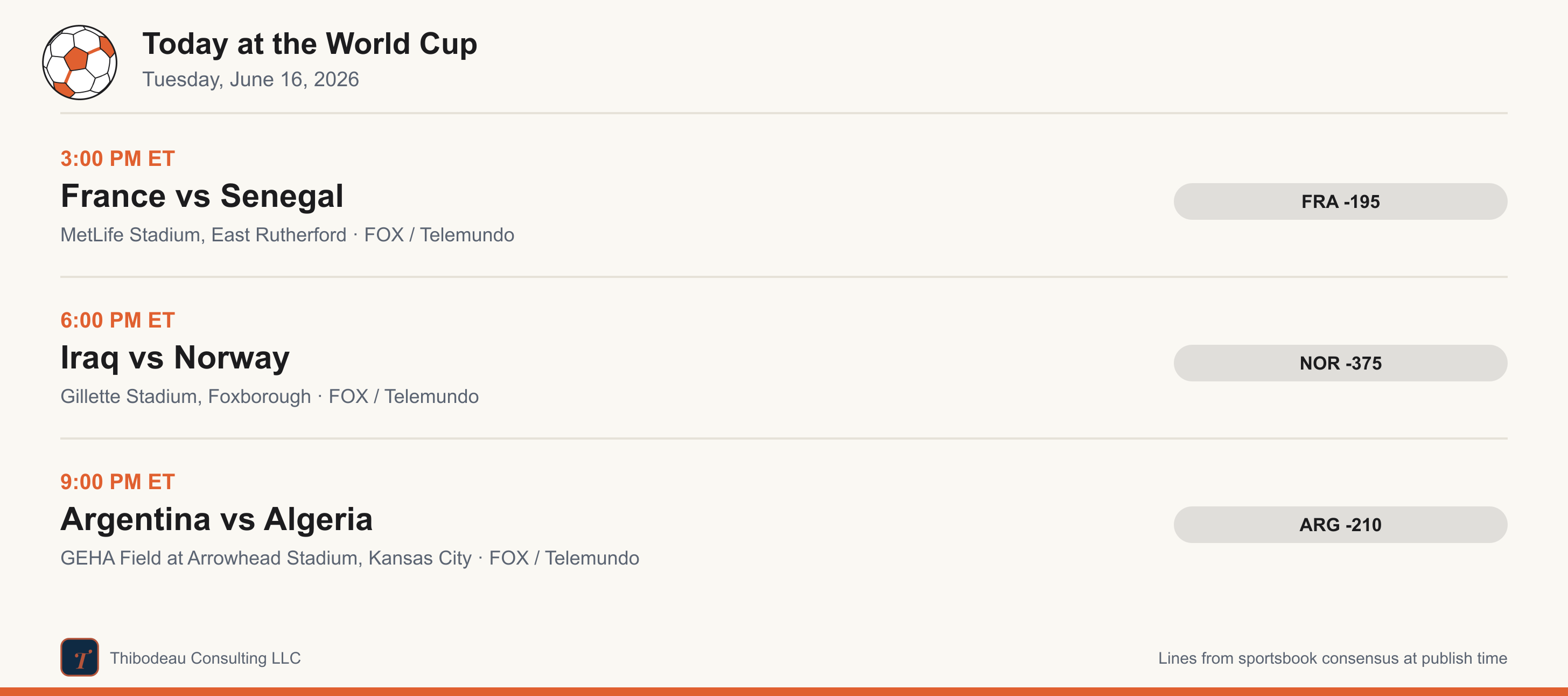
Day six, and Argentina arrives. The defending champion opens tonight against Algeria in Kansas City, carrying not just a trophy but the champion’s curse, which is the subject of today’s post. Before that, France gets Senegal and Iraq gets Norway. After three straight four-game days, the schedule eases back to a lighter three-match slate. But first, a quick recap.
Previously, at the World Cup
Day five was a full revolt against the obvious. Spain, the pre-tournament darling, opened with a scoreless draw against Cape Verde. Then Belgium was held to a draw by Egypt, as was Uruguay by Saudi Arabia, as was Iran by New Zealand. Four matches, four dropped points. Some models were less wrong than others, and the scoreboard updated accordingly. More on that at the end.
Question 6: Why do defending champions keep going home early?
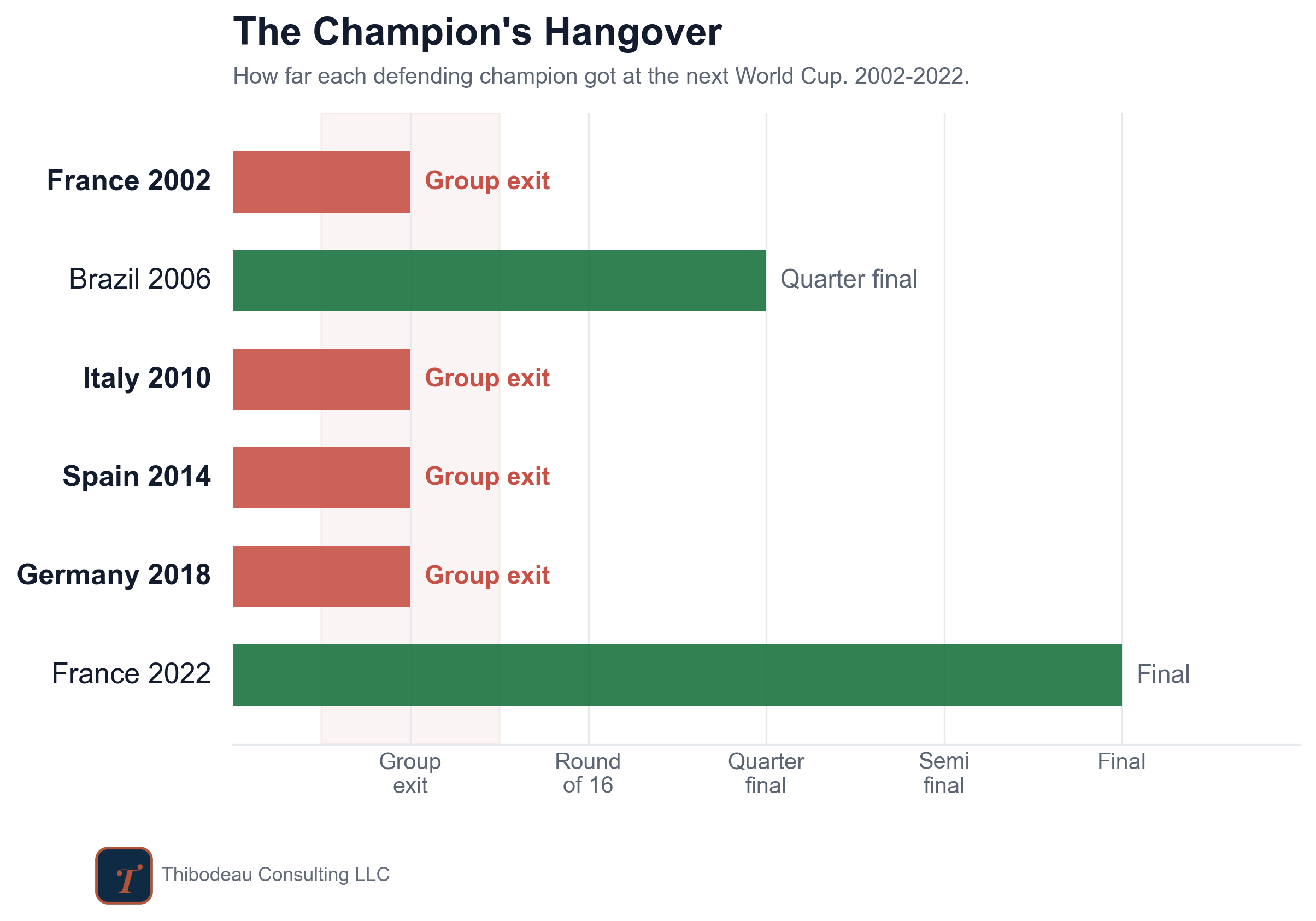
Line up the last six defending champions by how far they got at the next World Cup and you’ll notice a trend. Only two escaped the group-stage: Brazil reached the quarterfinals in 2006, and France reached the final in 2022. The other four went home early. That’s a 33 percent advancement rate, in an era when 50 percent of all teams advanced from the group.
Weird, right? The defending champion is not some random team. To arrive with the crown, you had to win the last World Cup, which is a pretty good clue that you were excellent at soccer. The team-quality ratings agree: defending champions usually enter the next tournament as elite. Then the group stage ruins the story.
Why would that happen?
The romantic explanation is psychological: the weight of the crown, the target on every back, complacency, the slow erosion of hunger. Those are fun, and maybe some are true. But the statistician points first to duller explanations that probably do more of the work.
A Small Sample
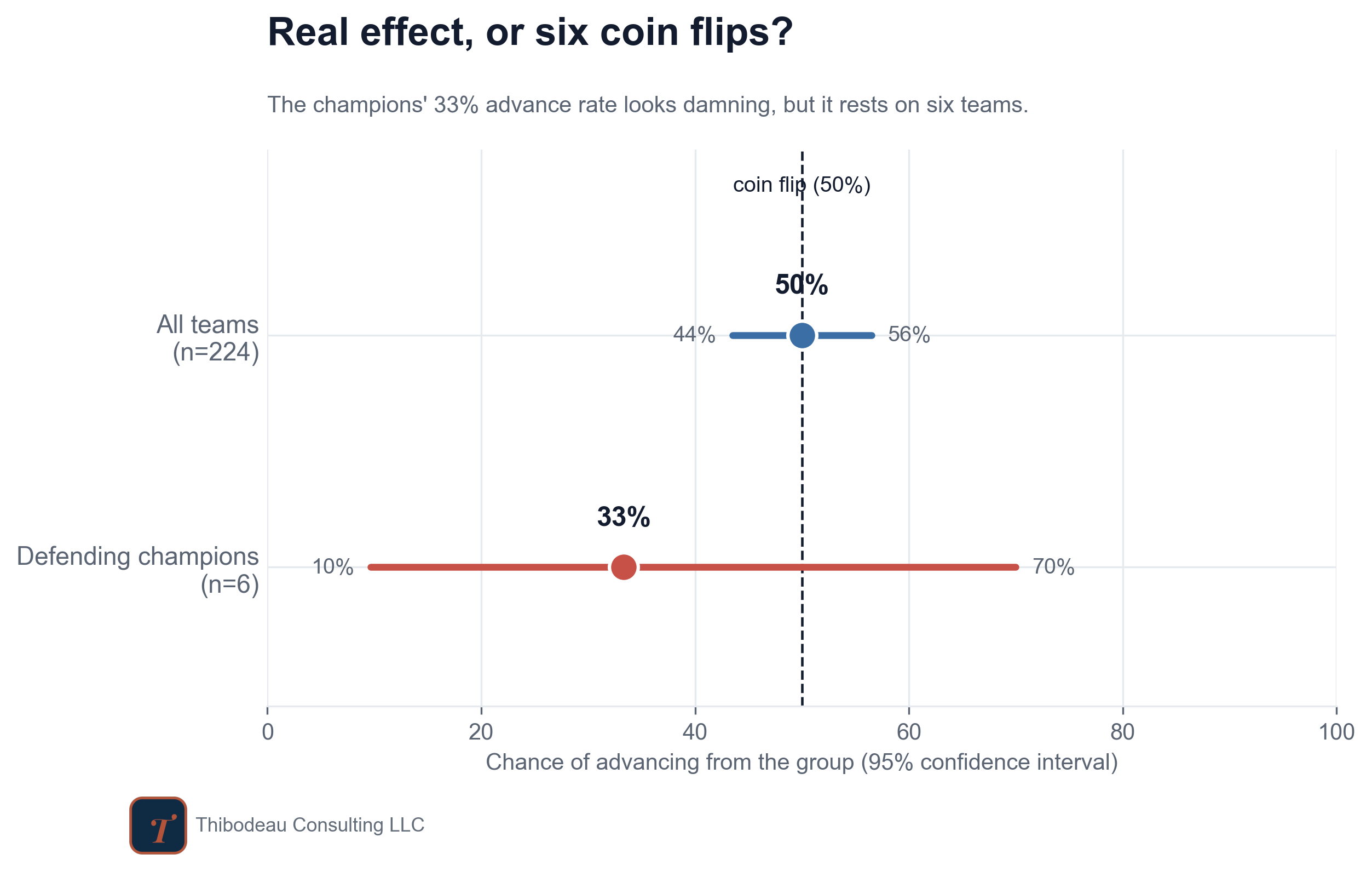
The first is sample size. The whole pattern rests on just six teams. If we had to use one number to estimate how often defending champions advance from the group, it would be 33 percent, comfortably below the 50 percent rate for an average team. But a careful data person would not stop at that point estimate. She would put a confidence interval around it to show how much uncertainty the number carries.
The red line in the plot below is that uncertainty. It stretches from about 10 percent to 70 percent. Part of it sits below 50, so defending champions might genuinely underperform. But part of it sits above 50, so they might still be better than average. Six teams simply cannot tell those stories apart. A future post will dig into probability and hypothesis testing, the tools for deciding when a pattern like this is real. For now, the honest verdict is: maybe there is a curse, maybe there is not.
Regression to the mean
The second explanation has a name: regression to the mean, and it is one of the most important forces in anything that mixes skill and luck. Any extreme result is part signal and part noise. The signal is the team’s real, durable strength. The noise is the randomness of the real world: the finishing streak, the bracket, the injuries that healed, the penalty that went in, the red card that did not come. A title run is a great team riding an unusually high wave. Four years later, the team may still be great, but the wave is gone.
Importantly, a regression is likely after a good run even if the team’s underlying quality has not changed at all. That is why the hottest fund cools off and the surprise test score drifts toward the student’s usual level. The champion returns to the World Cup looking more ordinary, not necessarily because it fell apart, but because the trophy flattered it a little the last time.
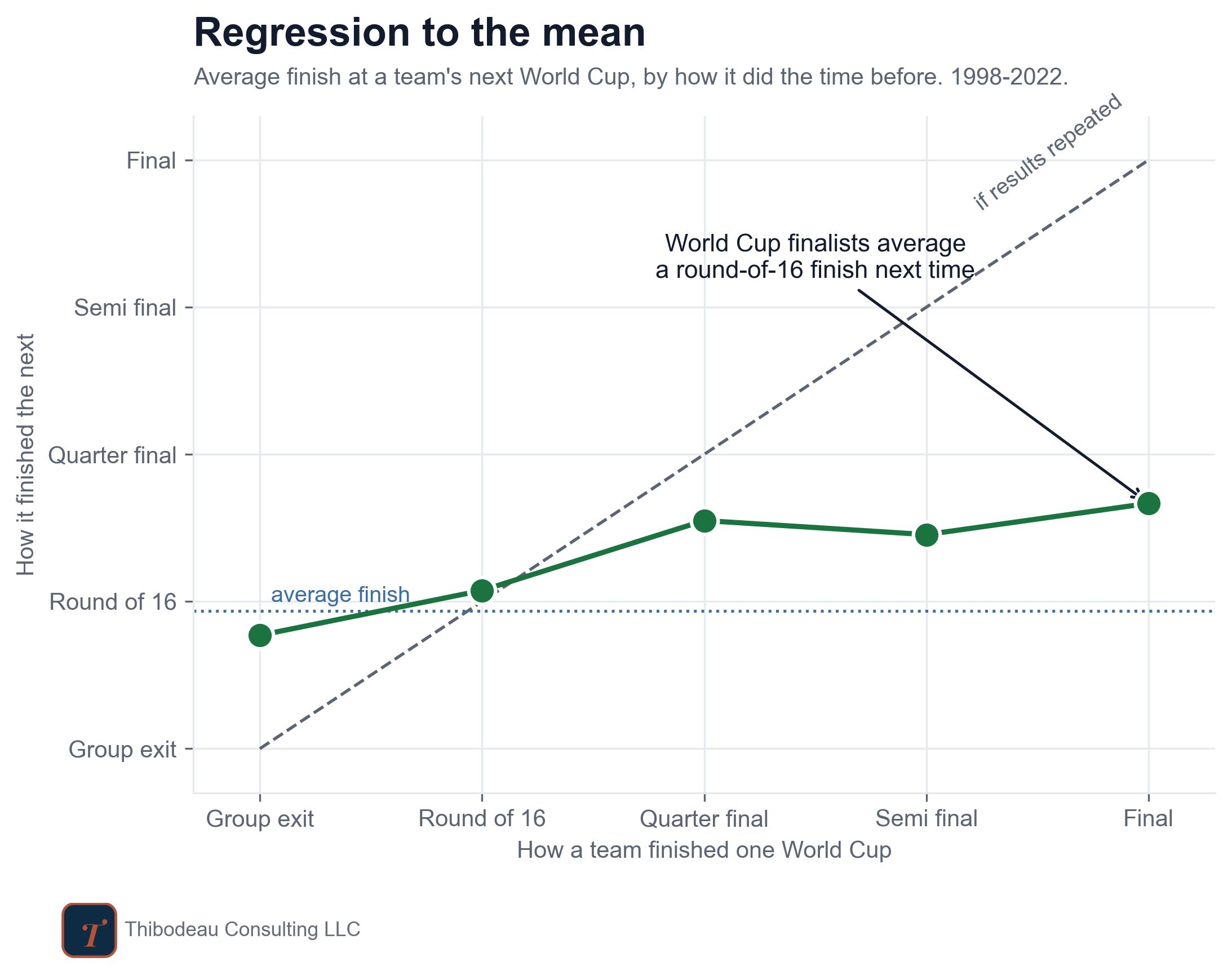
In the end, the champion’s hangover is probably not one thing. It is a small sample problem and regression to the mean, mixed with aging, pressure, and reputation. The crown is not just a talent measure but a tournament situation too: attention, expectations, and the impossible job of making a perfect month happen back-to-back.
Today’s Forecasts
Day five dragged every forecaster below the know-nothing line. Four draws and draws are the outcome every model leaves least room for. So everyone got hurt, and the boldest forecasts got hurt most. That was us yesterday, but there are still 88 games to play, including three today.
Through sixteen matches total, the cumulative scoreboard has Opta in front at 0.743, followed by the market at 0.750, Dimers at 0.753, Kalshi at 0.763, DSWC at 0.772, and PELE at 0.776. Lower is better. A know-nothing shrug that calls every match 33/33/33 scores 0.667, which means every forecaster, us included, is now scoring worse than the shrug.
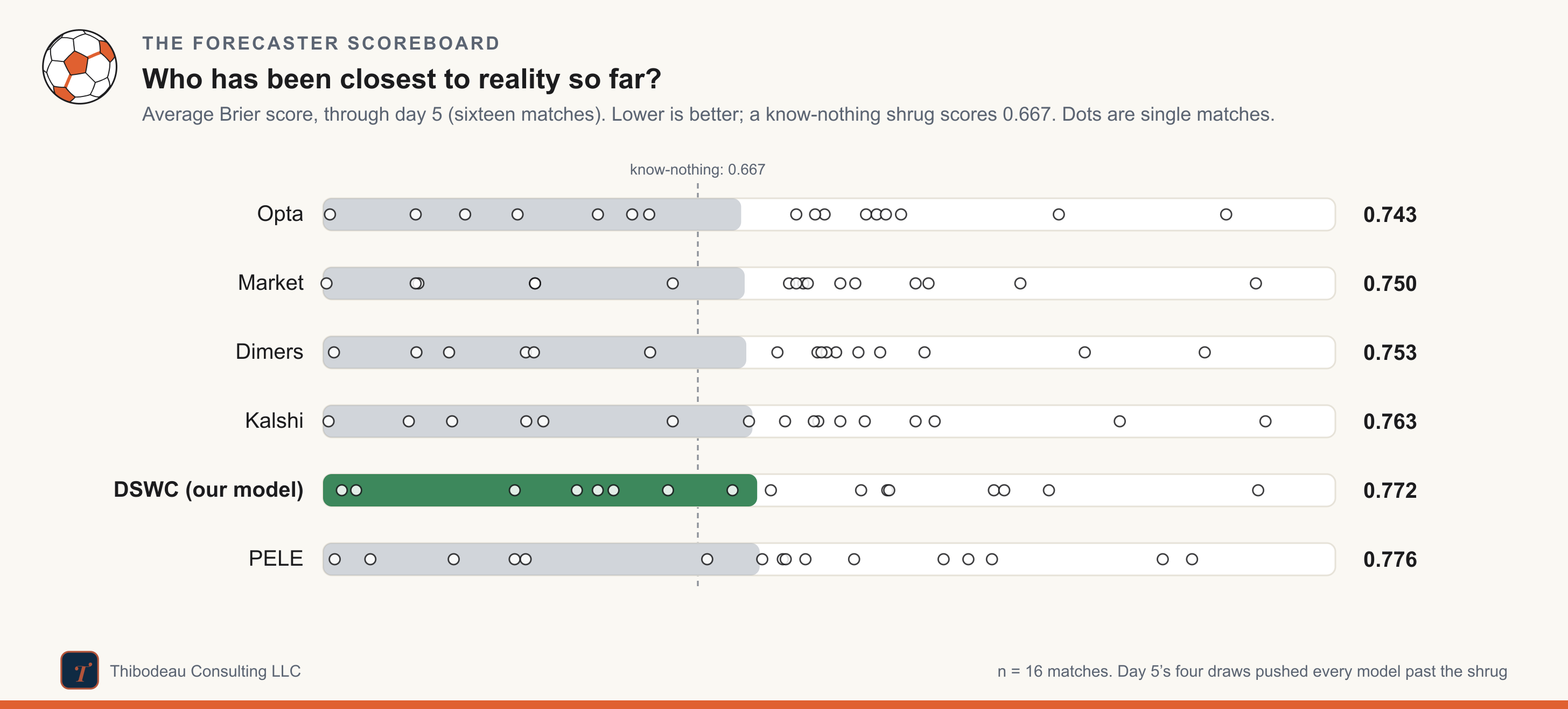
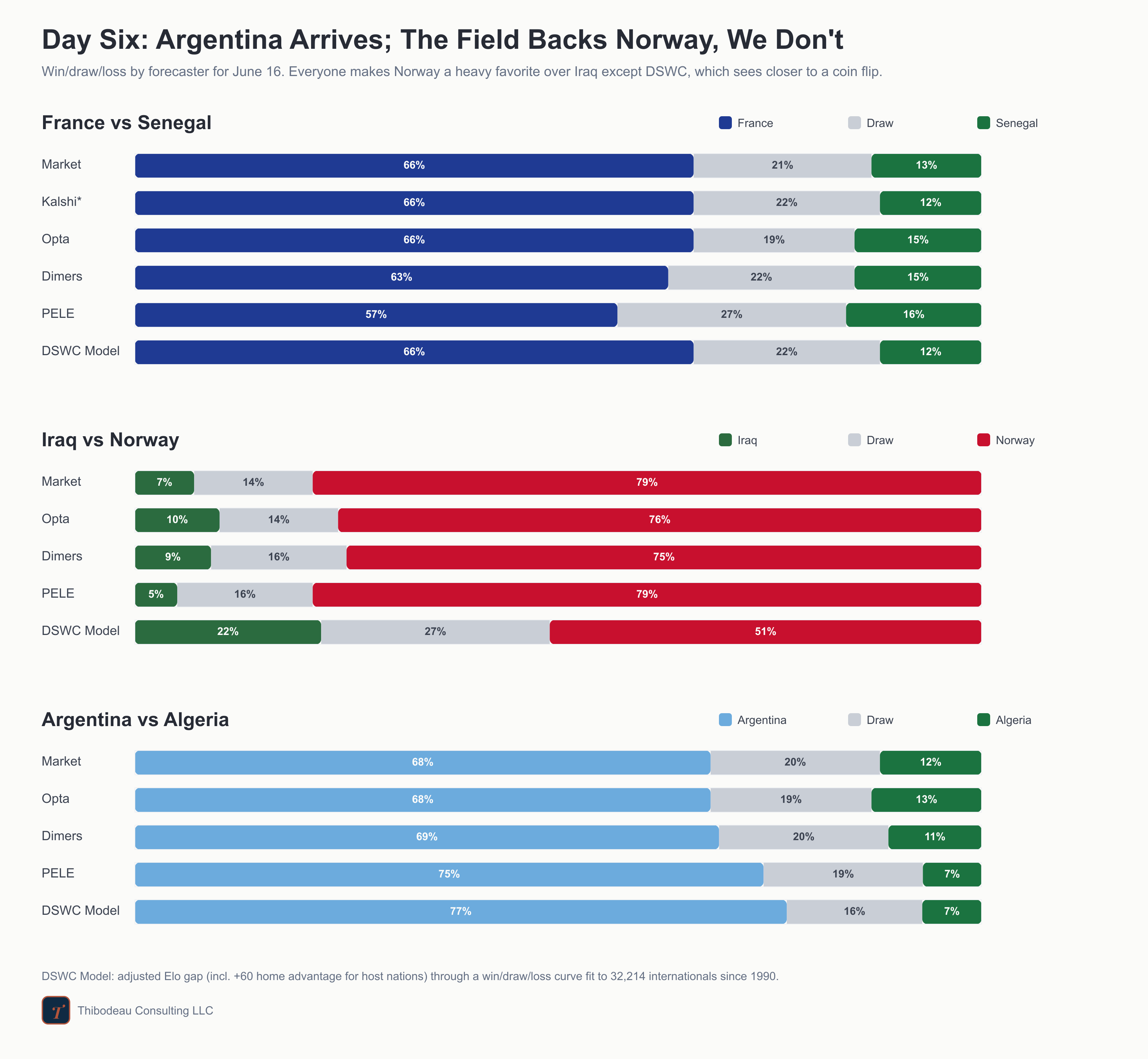
There are three games today, and the board mostly agrees on two: France should beat Senegal, and Argentina should beat Algeria. The argument is Iraq-Norway. The market, Opta, Dimers, and PELE all make Norway a heavy favorite, between 75 and 79 percent, whereas our model is more cautious, giving Norway a 51 percent chance to win.