When Is Third Place Enough?
Eight of twelve third-place teams advance, and goal difference is the fine print

Day fifteen, and the United States is back on the stage: already through, already first in the group, and facing a Turkey team that is already eliminated. By every reasonable measure, this is a glorified scrimmage. So naturally it is the one the whole country will treat as a referendum on national character. A meaningless game with a home crowd and a knockout round on the horizon is exactly the kind of thing American soccer was built to overreact to. Around it, the rest of the slate is asking today’s real question: what will it take? Germany-Ecuador and Japan-Sweden are the grown-up games, Paraguay-Australia is the table-math game, and Ivory Coast-Curaçao and Netherlands-Tunisia are where favorites can either finish the job or make the third-place board sweat. But first, a quick recap.
Previously, at the World Cup
Day fourteen was the first full lesson in final-round arithmetic. Mexico, who was already through, beat Czechia 3-0 to send the Czechs home. In the other Group A match, South Africa did what it had to do and South Korea could not afford, winning 1-0 to take second place and push Korea into the third-place waiting room.
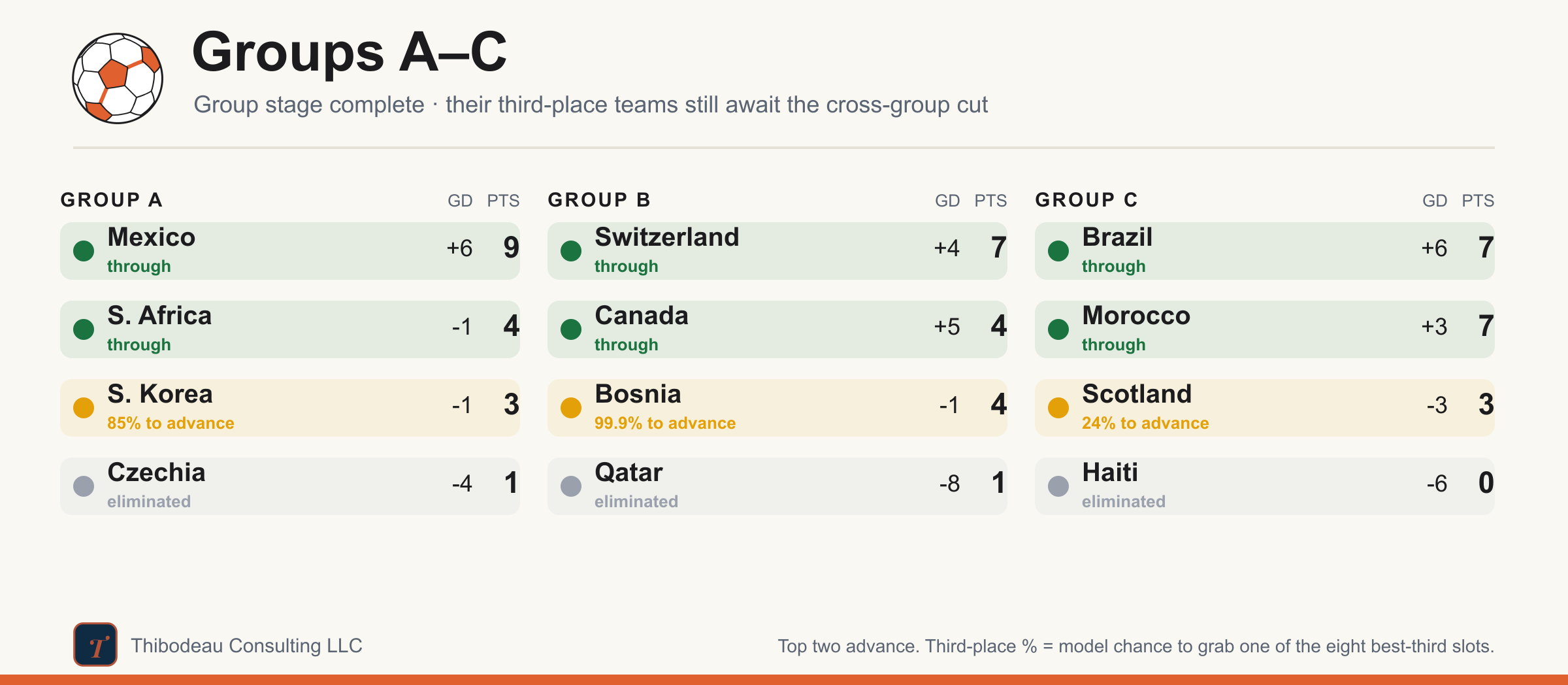
Group B gave us the clean incentive game, and Switzerland chose first place rather than comfort, beating Canada 2-1 in Vancouver. Bosnia and Herzegovina did its job too, beating Qatar 3-1, but four points were only enough for third because Canada’s goal difference held up.
In Group C, Brazil and Morocco both took care of business, Brazil 3-0 over Scotland and Morocco 4-2 over Haiti, leaving Scotland as another three-point third-place team now staring at the rest of the board.
On the modeling side, Classic struggled but was rescued by one very loud call: Mexico. Where the market had trimmed an already-qualified Mexico to a coin flip at 51 percent, Classic stayed heavy at 69, and Mexico won 3-0 without breaking a sweat. Everything else cut the other way. The scoreboard updated accordingly.
Question 15: What will it take to survive from third place?
The new World Cup format has created a strange middle class. First or second in your group and you are through. Third place is different: it is not a position so much as an application.
Twelve teams will finish third. Eight will advance. Four will go home. So the interesting question is not, “Did you finish third?” It is, “What kind of third did you finish?”
In today’s post, we simulate the last three days of the group stage, using current market odds as a baseline for predicting the outcomes of those games. We’ll explain how that works and then zoom in on each group situation as it stands.
How third place works in the new World Cup
The tournament has twelve groups of four. The top two teams in each group advance automatically, which fills 24 of the 32 knockout spots. The remaining eight places go to the best third-place teams.
Mechanically, the way this works is that FIFA creates a separate table made only of the twelve teams that finished third in their groups. Those twelve teams are ranked by their full group-stage records. The first tiebreaker is points. Then goal difference. Then goals scored. Then disciplinary record. Then, if somehow all of that still has not separated them, FIFA ranking.
That means third place is not one thing. Four points in third is almost always a passport. Three points is a resume. Two points is a prayer. And goal difference matters because it is the first thing that separates the many teams likely to finish on the same number of points.
To get a handle on that, we simulated the rest of the group stage.
The simulation set up
The idea behind the simulation is straightforward. We know the table after June 24. We know which groups are already finished, which teams have one match left, and the market’s odds for those remaining matches. So instead of trying to solve the tournament with one prediction, we play it out a hundred thousand times.
In each simulation, every remaining match gets a scoreline, sampled so that wins, draws, and losses land at their market rates. Sometimes the favorite wins. Sometimes the draw hits. Sometimes the underdog changes everything. The goals matter too, because goal difference is the tiebreaker that sorts the third-place teams. Then we rebuild the tables, rank the twelve thirds, and ask the same question each time: who gets through?
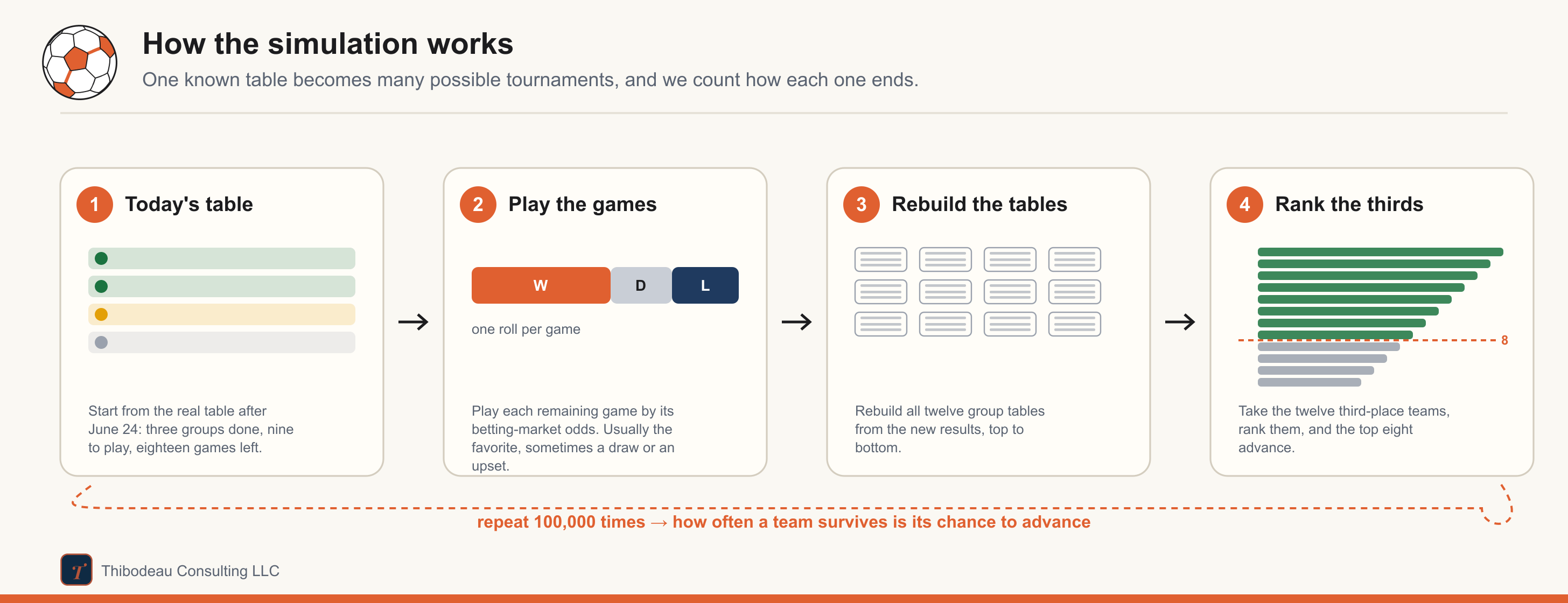
That is Monte Carlo simulation. It is less a crystal ball than a way of counting futures. If a team advances in 82,000 of 100,000 simulated tournaments, we say its advancement probability is about 82%. Not because we know what will happen, but because under these assumptions, that is how often the path stays open.
The simulation results
The first result is the big one: the cutoff is almost certainly going to be three points.
In our simulations, the final third-place cutoff landed at three points in about 99% of tournament futures. Four points was needed only rarely. Two points was enough only in the strangest versions of the bracket.
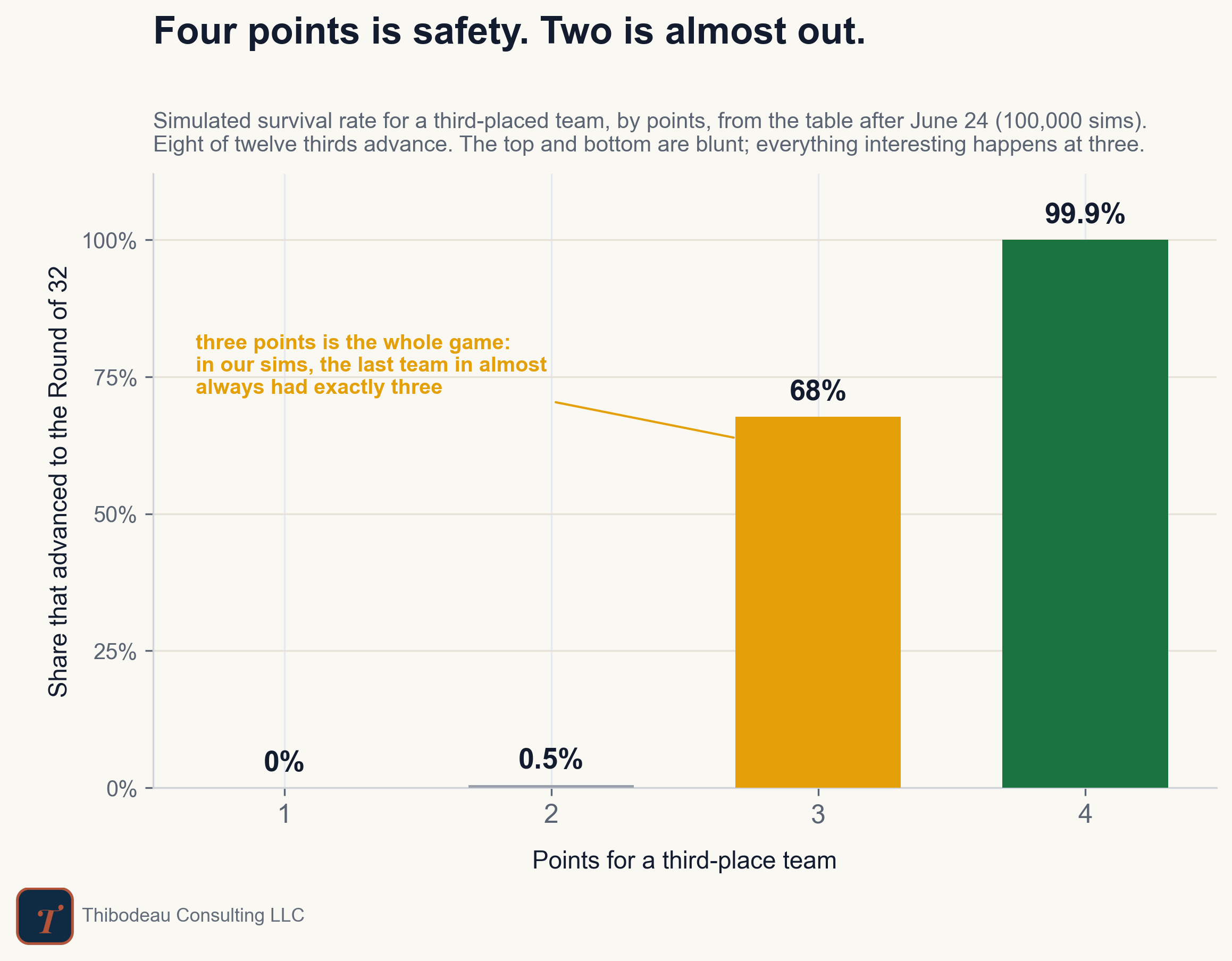
That gives us the useful rule of thumb:
Four points is safe.
Three points is a bubble case.
Two points is almost certainly done.
But not all three point situations are the same. In the simulations, the average third-place table had about four teams on four points and about six teams on exactly three. That is the traffic jam. The four-point teams are above the fray; the three-point teams are fighting each other and that comes down to goal difference.
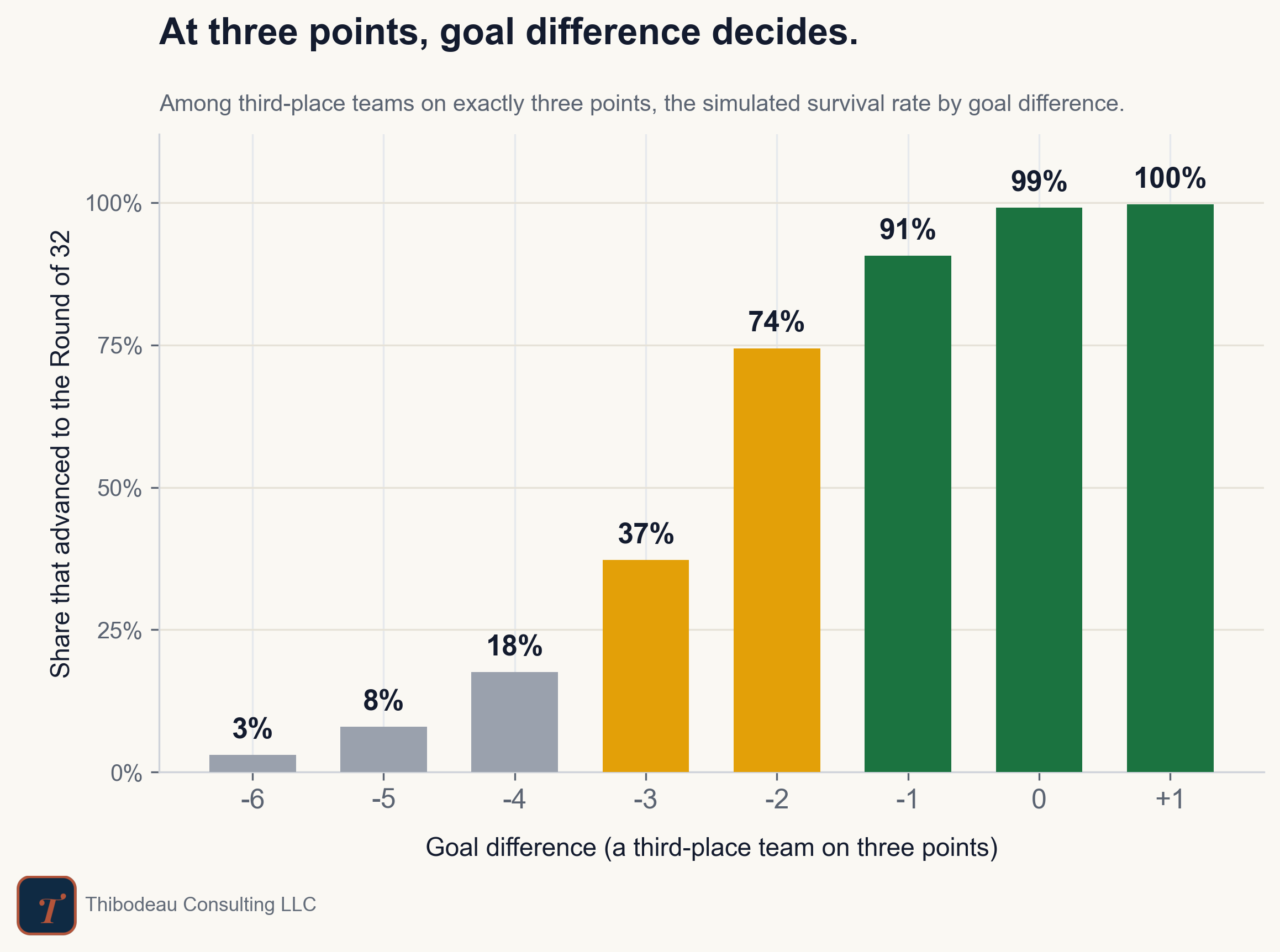
Line up every simulated third-place team that finished on three points, sort them by goal difference, and an even ledger turns out to be almost as good as a fourth point. Zero or better advanced about 99 percent of the time. Minus one still cleared comfortably, at 91 percent. Minus two is where it tightens, to 74. Minus three is a coin flip that lands wrong more often than right, at 37. Below that the floor simply gives way: 18 percent at minus four, 8 at minus five, 3 at minus six.
We are not alone here. Opta ran the same exercise on its own supercomputer and landed in almost exactly the same place: a third-placed team advanced 99.8 percent of the time on four points and about two-thirds of the time, 66.8 percent, on three, with goal difference splitting the three-point teams.
So where do teams stand?
You can already see this in the three groups that finished on June 24.
Bosnia finished third in Group B with four points. The model treats that as essentially done. They don’t really have to look at the cross-group table.
South Korea finished third in Group A with three points, a goal difference of minus one, and two goals scored. From there, our simulation gives them about an 85 percent chance to survive. A three-point third with a tidy ledger.
Scotland also finished third with three points in Group C. But they did it at minus three, with a single goal scored all tournament. Their chance is about 24 percent.
Same finishing position. Same number of points. One team is almost safe and the other is a long shot, and the only thing that changed is the goal column. That is the format in one picture.
The nine groups still settling
Here is how the model reads the unfinished groups, by each team’s overall chance to advance.
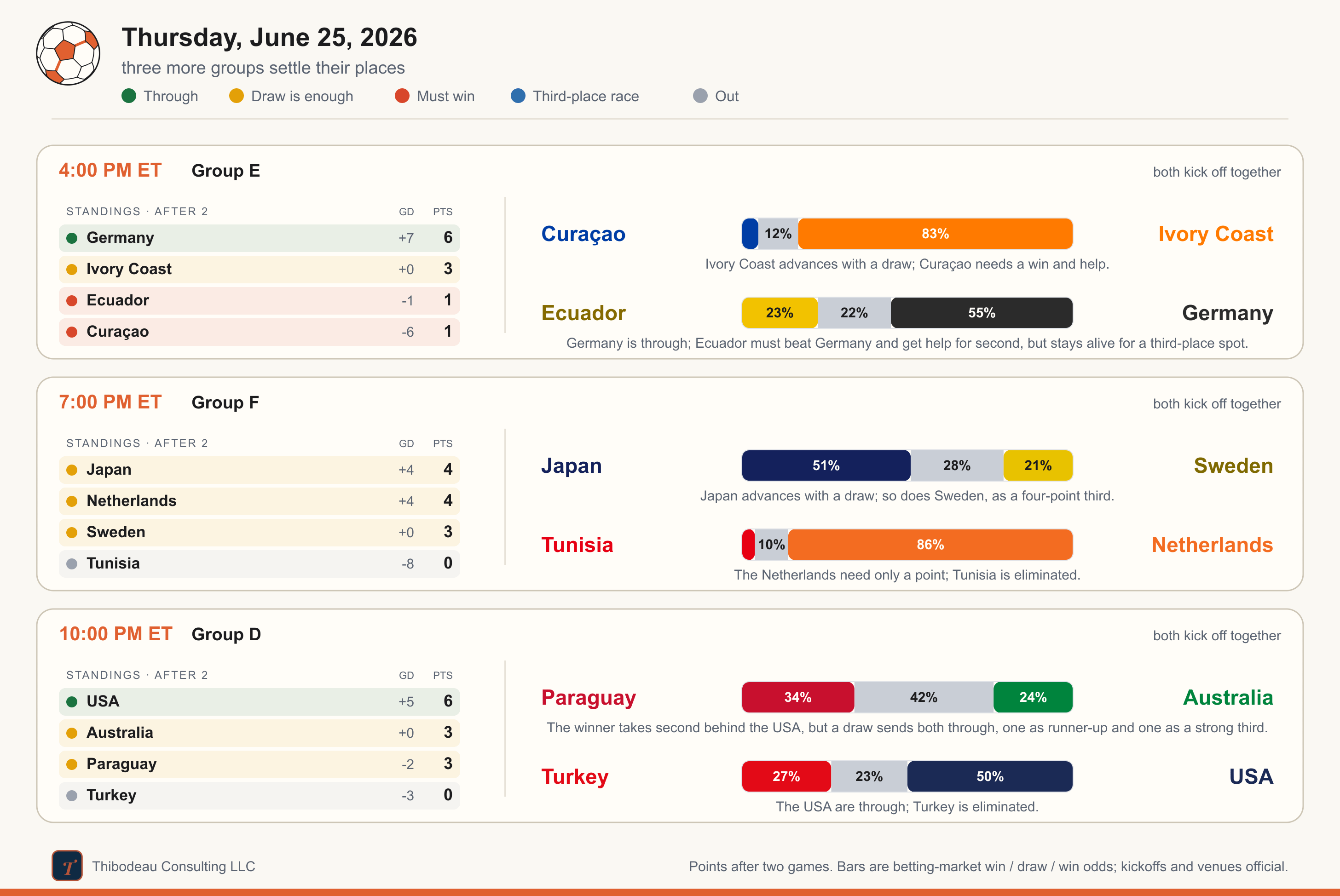
Group D. The USA are safe. Paraguay and Australia meet with second place on the line, but the loser probably survives anyway as a strong third-place team: Australia are at 95 percent, Paraguay at 89. Turkey are out.
Group E. Germany are safe. Ivory Coast are almost there at 98 percent and advance with a draw. Ecuador (23 percent) and Curaçao (5 percent) are both playing for a path rather than comfort: they need a win, and then they need the third-place table to cooperate.
Group F. Japan and the Netherlands are safe. Their games are mostly about first and second. Sweden are the format case here: only 21 percent to finish top two, but 93 percent to advance because third place is likely to be good enough. Tunisia are out.
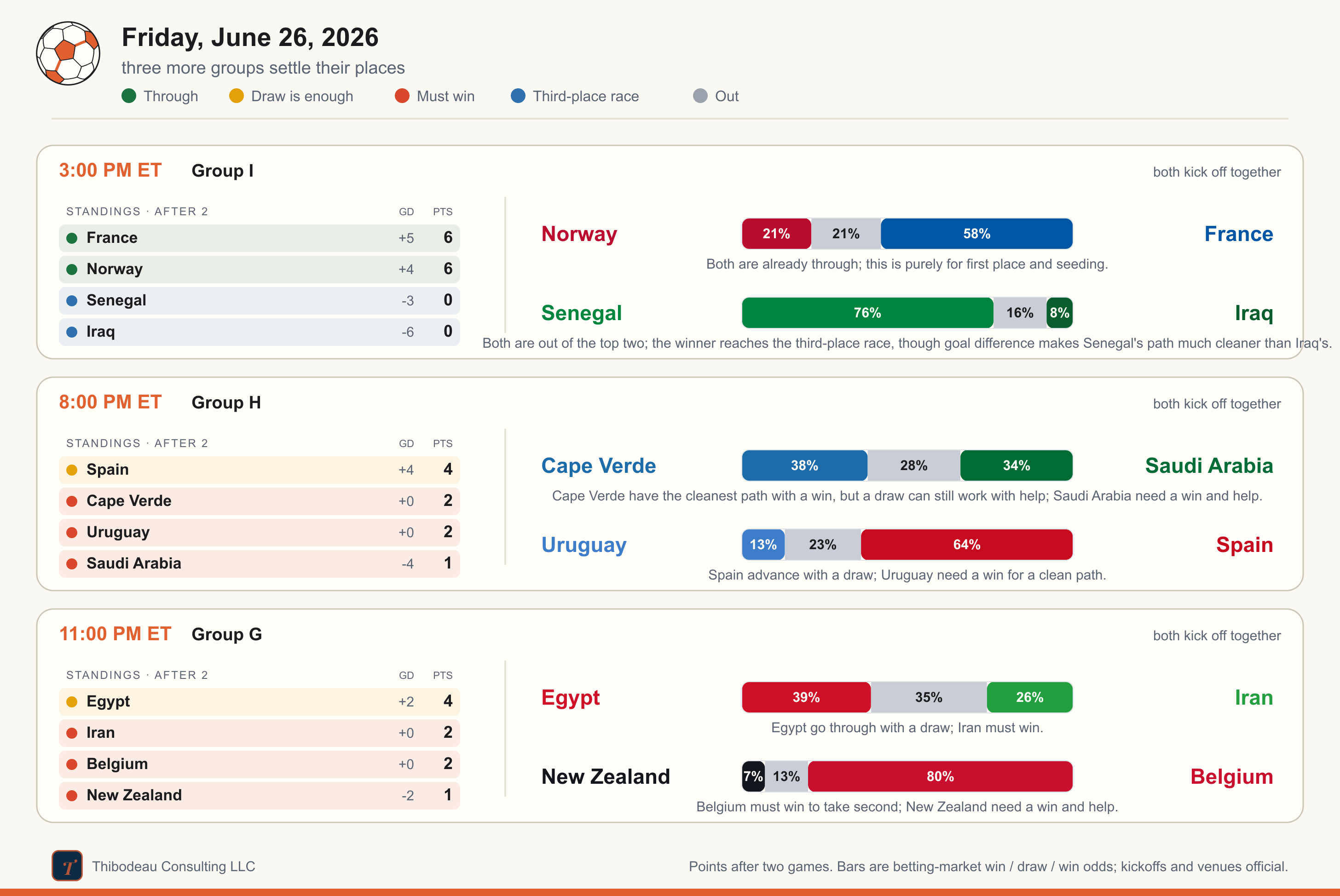
Group G. Egypt are safe; even third place should be enough. The fight is behind them. Belgium are in strong shape at 93 percent, but still need to beat New Zealand to be clean. Iran are alive at 61 percent because a win over Egypt likely sends them through, and even third place may leave a path.
Group H. Spain are safe. The second spot is messy: Cape Verde are the best positioned at 66 percent, but Saudi Arabia (34 percent) can jump them with a win. Uruguay (36 percent) need to beat Spain for the clean path; otherwise they are mostly asking the third-place table to save them.
Group I. France and Norway are already through, so their game is seeding. Senegal-Iraq is the third-place game. Senegal are at 69 percent because a win gives them a strong enough résumé. Iraq are at 1 percent because even a win probably leaves them buried on goal difference.
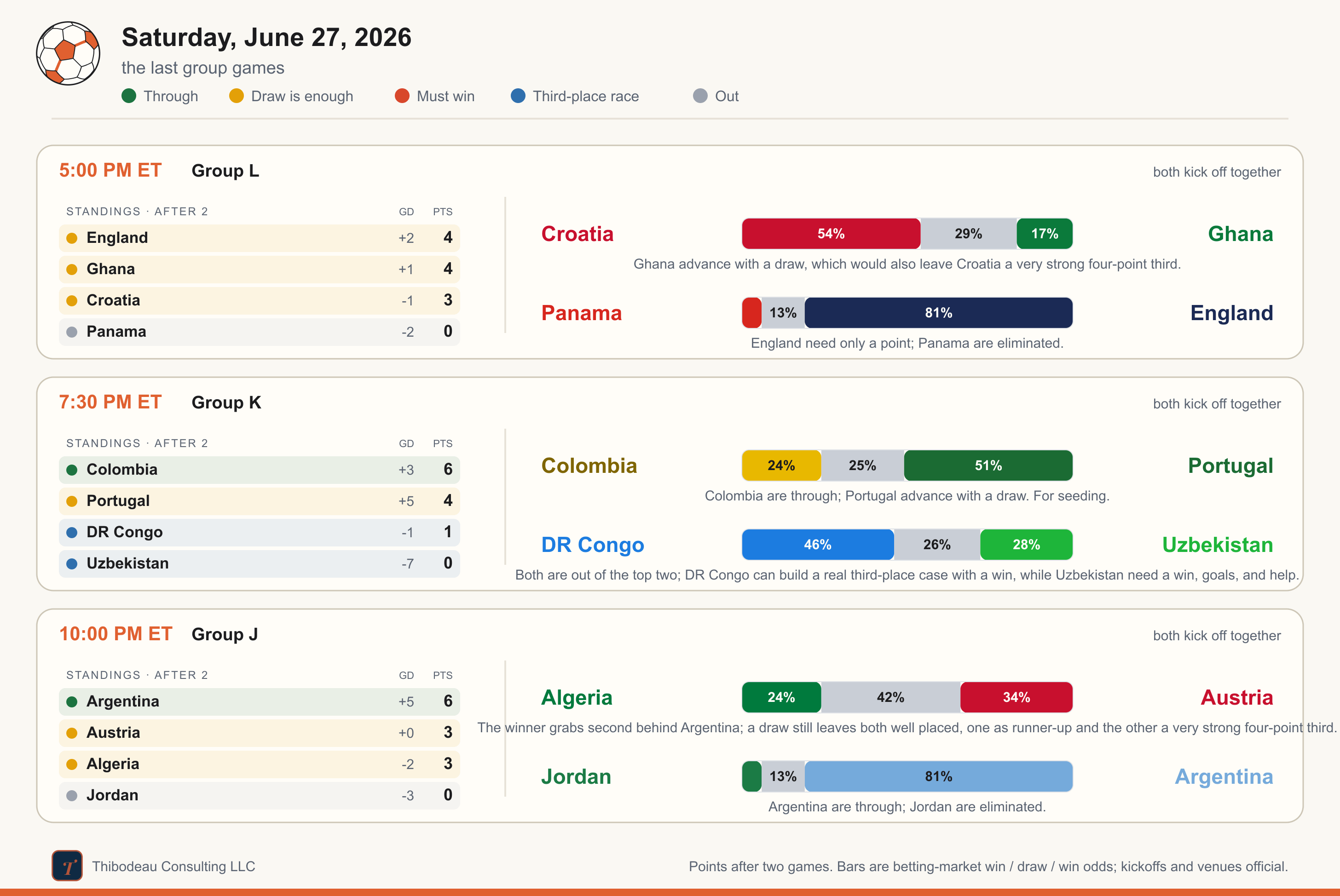
Group J. Argentina are safe. Austria and Algeria are almost both safe too: Austria are at 97 percent, Algeria at 81. Their head-to-head decides second place, but the loser is usually a strong third-place team, especially if the match is drawn.
Group K. Colombia and Portugal are safe. DR Congo are the live third-place case at 46 percent: beat Uzbekistan and they have a real résumé. Uzbekistan are at 1 percent because even a win leaves them fighting a brutal goal difference.
Group L. England are safe. Ghana are effectively safe too at 100 percent, because even third place would leave them on four points. Croatia are also in excellent shape at 95 percent, but still have more work to do: a result against Ghana likely settles it, while a loss leaves them sweating the third-place table.
Today’s Scorecard and Forecasts
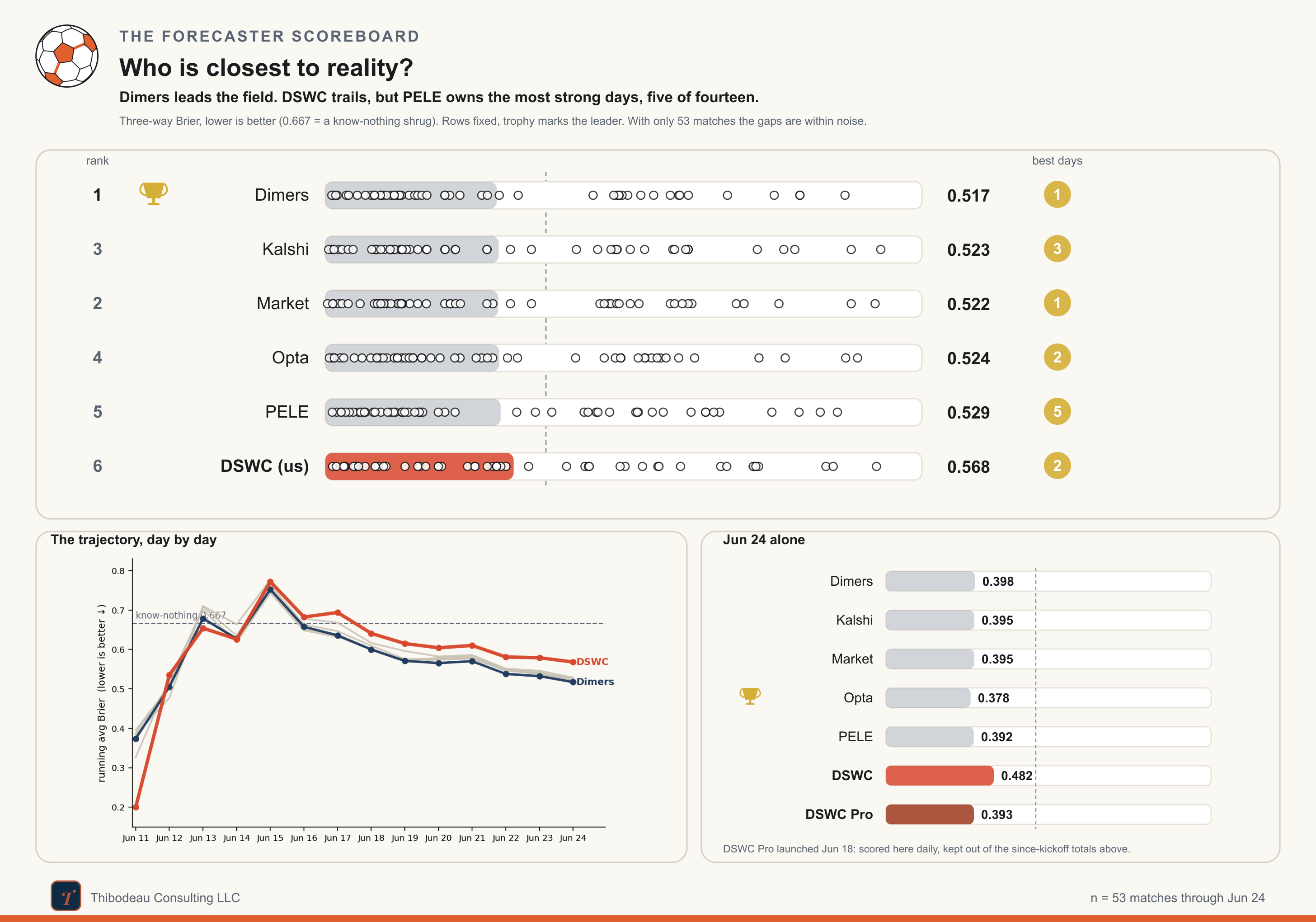
Yesterday did Classic no favors. June 24 was its worst single day of the tournament so far, grading at 0.482 while Opta won the slate at 0.378. The bright spot is the model we are not yet counting in the cumulative table. DSWC Pro, live since June 18, graded 0.393 on the day, with the front pack. We are keeping it out of the full leaderboard until it has a fair sample, but it is quietly making the case that the upgrade is real.
Through fifty-three matches, the table looks much as it has for the last week. Dimers leads at 0.517, and the rest of the outside field is packed in just behind: Market at 0.522, Kalshi at 0.523, Opta at 0.524, and PELE at 0.529. With only fifty-three matches, those gaps are tiny. Classic sits last at 0.568, which is still not enough evidence for a trial by fire, but it is enough to say the old model has been leaking points. The three-way Brier score rewards being both right and calibrated, and so far Classic has been a little too confident in the wrong places.
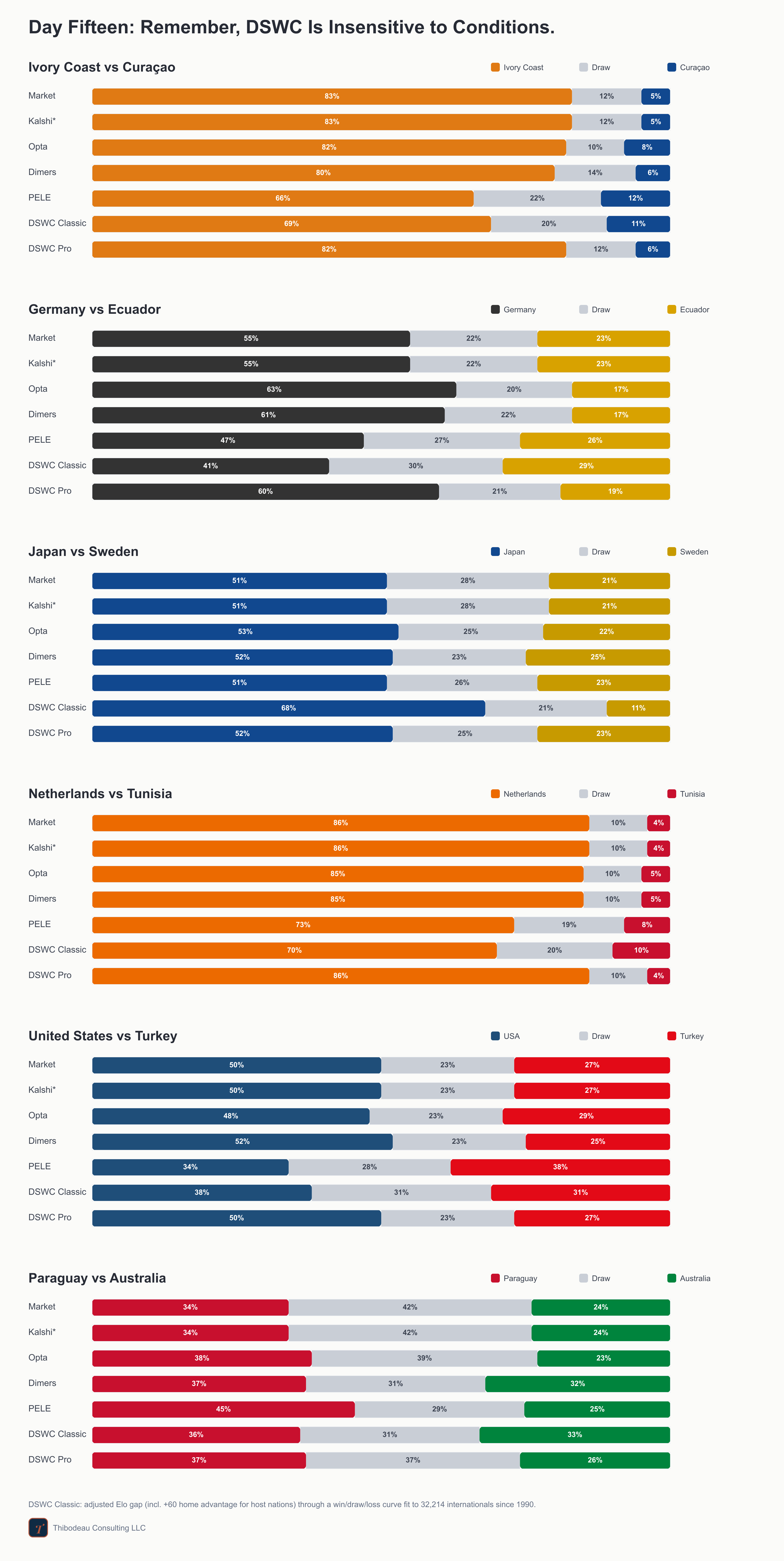
Day fifteen gives us six more final group games, and the slate is split between favorites finishing paperwork and teams still trying to define “enough.” Germany-Ecuador is the best pure model fight: the field sees Germany’s form, Classic sees two nearly even ratings. Japan-Sweden is our model’s biggest lonely stand, with Classic much higher on Japan than everyone else. Paraguay-Australia is the clean table game, because a draw quietly sends Australia through on goal difference and leaves Paraguay sweating the third-place table. The United States has already won its group before facing Turkey, while Ivory Coast and the Netherlands are trying not to turn comfortable positions into third-place math.