
Did water breaks change the World Cup?
How FIFA’s new emphasis on player safety, definitely not ad revenue, is changing the game

Day sixteen is built for distraction. There is a marquee striker duel to savor when Norway face France, and a United States loss to pick apart. Both are worth your afternoon. Neither is the real point today. Underneath the noise, the third-place bubble keeps shrinking, and the stakes climb a notch with every group that closes.
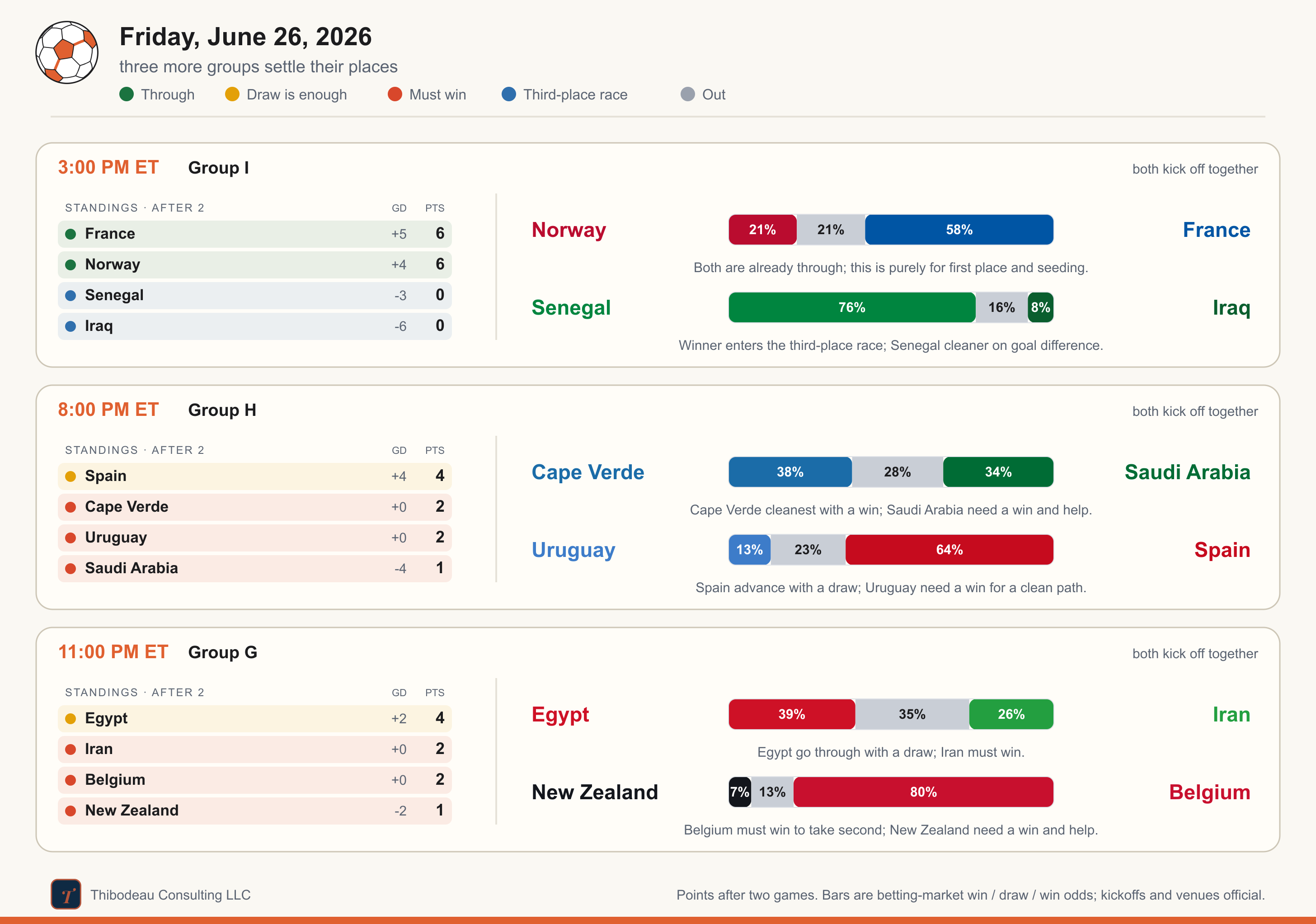
The schedule lays it out in three acts. First, France and Norway sort out first place in Group I, while Senegal and Iraq, both stranded on zero, try to climb into the third-place race. Then come the messier finales. In Group H, Spain can go through with a draw against Uruguay, while Cape Verde, Uruguay, and Saudi Arabia are all still alive in some form. Late, Group G closes the night: Egypt need only a point, Iran and Belgium both need wins, and New Zealand need a win and help.
On the penultimate day of the group stage, the strangest controversy of the tournament so far is not a red card, not a VAR call, and not a tactical meltdown. It is the water breaks. That’s today’s topic. But first, a quick recap.
Previously, at the World Cup
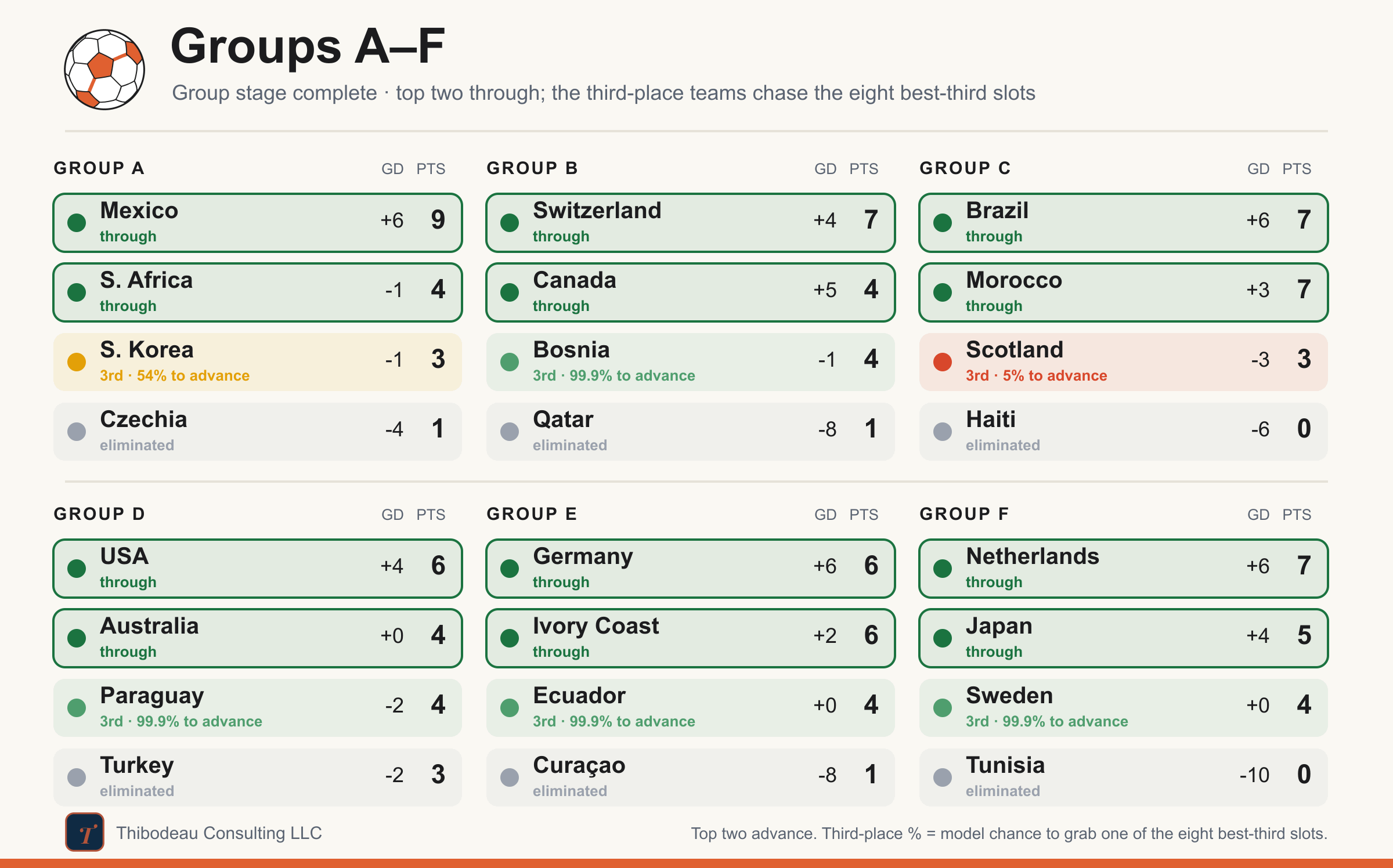
The final-round math got sharper. Ivory Coast handled Curaçao 2-0 to take care of Group E, while Ecuador’s 2-1 upset of Germany was just enough to make the third-place table with four points. In Group F, the Netherlands beat Tunisia 3-1 and won the group, Japan’s 1-1 draw with Sweden carried both teams forward, and Tunisia went home. Then the night ended with the loud result: Turkey beat the United States 3-2, but the USA still won Group D, Australia’s 0-0 draw with Paraguay was enough for second, and Paraguay joined the four-point third-place pile. Turkey got the win and the exit.
Question 16: What happens when soccer gets a timeout?
Soccer has always been proud of its refusal to stop. The clock runs. Managers shout into the noise. Problems get solved in motion.
This year is different. Every match gets a water break in each half, even the ones in Vancouver, where June sits around 65 degrees and the roof is closed. FIFA says the policy is about player safety, and in plenty of venues that concern is real. It is also true that a three-minute pause in each half looks awfully convenient for a tournament with billions of dollars of broadcast inventory to sell.
Today’s question is narrower than the ad-money argument: how have the breaks changed the rhythm of the game? And how do we measure that?
There are at least three plausible mechanisms, and they point in different directions.
Do breaks help the attack?
The first theory is the simplest: a break helps tired attackers. They get a breath, a drink, and a word from the touchline, then come back ready to keep pushing. If that theory is right, the minutes after the pause should get louder. More shots. More pressure. More goals.
Early in the tournament, Opta found a number that seemed to fit. On matchday one, first-half shots jumped after the hydration break: 170 after the pause, against 115 before it. That is a 1.48x rise. On the surface, it looks like evidence that the break opened the game up.
But a ratio like that needs a yardstick before it means anything.
That yardstick is the base rate: what normally happens before we start telling a special story. Soccer is not evenly spread across the clock. The later part of a half is usually busier than the earlier part. Legs tire, defenses stretch, game states sharpen, and teams push before the whistle. So “more shots after the break than before it” is not automatically a water-break effect. It may just be the normal shape of a half.
That is what the chart below shows. The bars are this tournament’s goals, broken into roughly seven-minute windows. The line is the historical pattern from World Cup group stages between 1998 and 2022. The breaks sit on the bin edges. The orange bars are stoppage time.
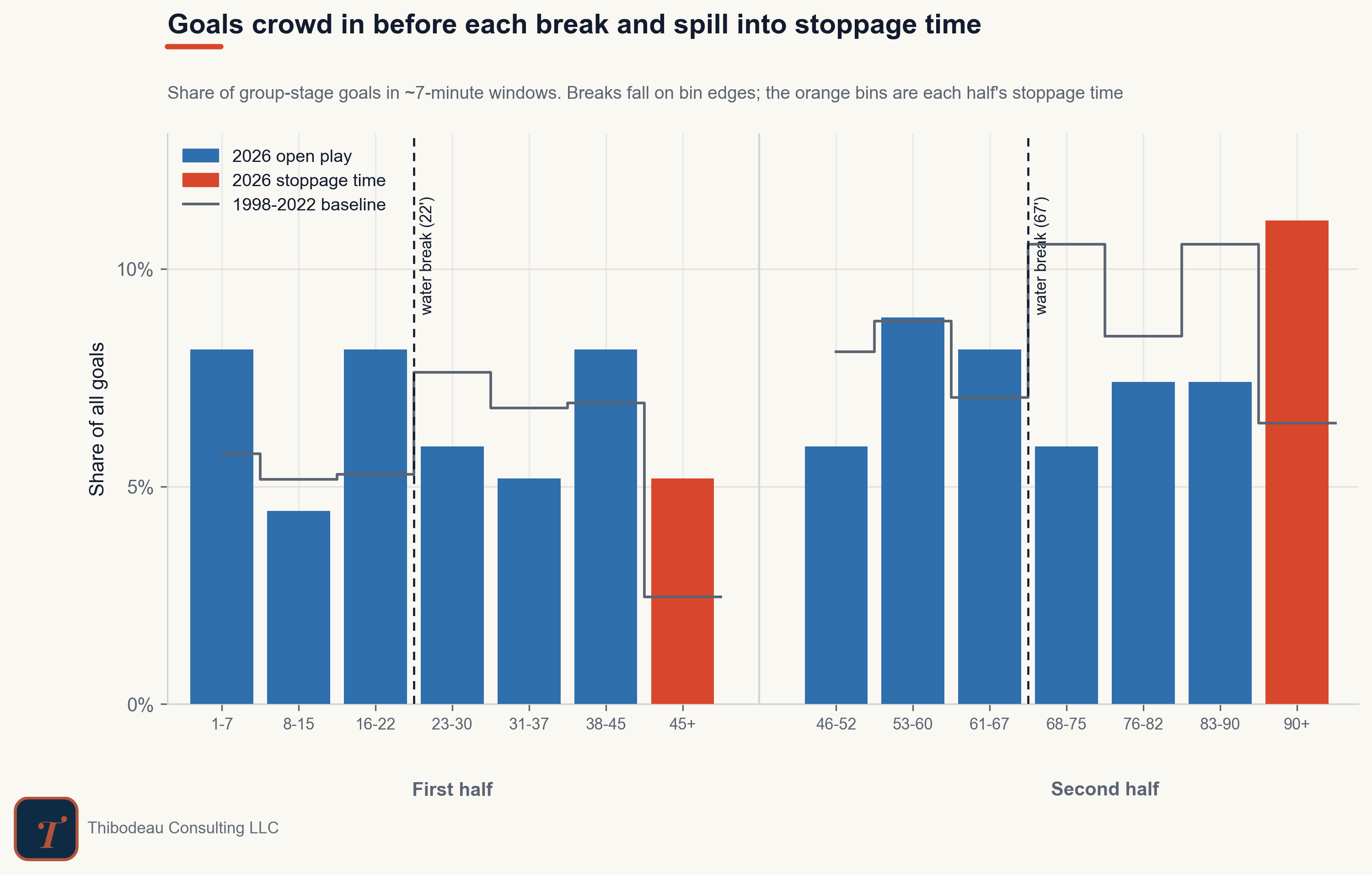
Historically, goals in the later first-half window were 1.47 times as common as goals in the earlier window. Opta’s matchday-one shot ratio was 1.48. So the number was real, but it was not yet a finding. It sat almost exactly on top of the base rate.
This year’s goal split points the other way. Through the sample we have, first-half goals are only 1.2 times as common after the break window as before it. That is lower than the historical norm. Taking the base rate seriously does not strengthen the attacking theory. It weakens it.
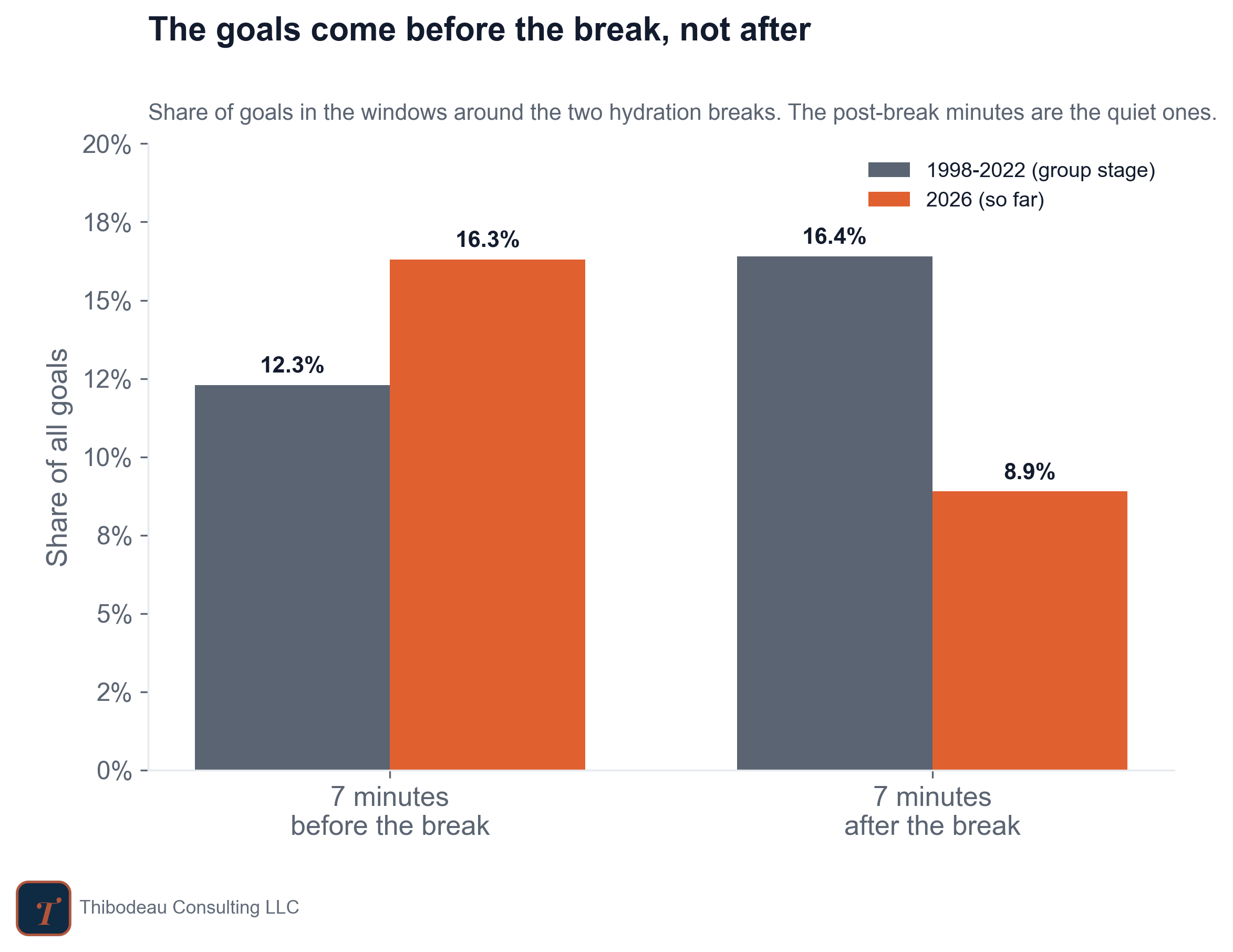
The second chart zooms in on the exact windows around the two breaks. Only 8.9 percent of 2026 goals have come in the seven minutes after a hydration break. Historically, those same clock windows held 16.4 percent of goals. The minutes just before the breaks moved the other way: 16.3 percent this year, against 12.3 percent historically.
So the attacking-surge case falls apart. Teams are not scoring out of the pause. They are scoring on the way into it.
Do breaks help the defense?
That brings us to the opposite theory: maybe the break helps the defense. Maybe it lets the team under pressure breathe, gives the manager a chance to fix the shape, and snaps the rhythm of whoever has been pushing. This is the “momentum stopper” theory, and the quiet post-break windows give it some support.
But only the soft version.
If the break were really rescuing teams that had lost control, we would expect the goals after the pause to come disproportionately from the team that was behind. That is not what happens. Of the 76 goals scored after a break, 30 came from teams that were already ahead at the break. Another 26 came from teams that were level. Only 20 came from teams that were trailing.
So the break may cool the match down. It may interrupt pressure. But it does not look like a comeback machine. The teams already in control are still the teams most likely to score afterward.
That leaves the best-supported version: hydration breaks are not attacking accelerators, and they are not magic resets for the team in trouble. They are rhythm breaks. The game gets quieter immediately after them, then the missing action shows up somewhere else: stoppage time.
Do breaks move the action to stoppage time?
The third theory is less dramatic, but it fits the data best. Maybe the break itself is not the point. Maybe the point is the time it creates.
A three-minute pause in each half does not disappear. The referee has to put it somewhere, and somewhere usually means the end of the half. That matters because stoppage time is not ordinary time. It is desperate time. Teams know the whistle is close. The losing side throws numbers forward. The leading side faces tired legs and stretched spacing. In this format, even a consolation goal can matter because goal difference is part of the third-place sorting machine.
That is where the clearest signal shows up. In our 2026 sample, 16.3 percent of goals have come in stoppage time. From 1998 through 2022, the group-stage baseline was 8.9 percent. That is almost double.
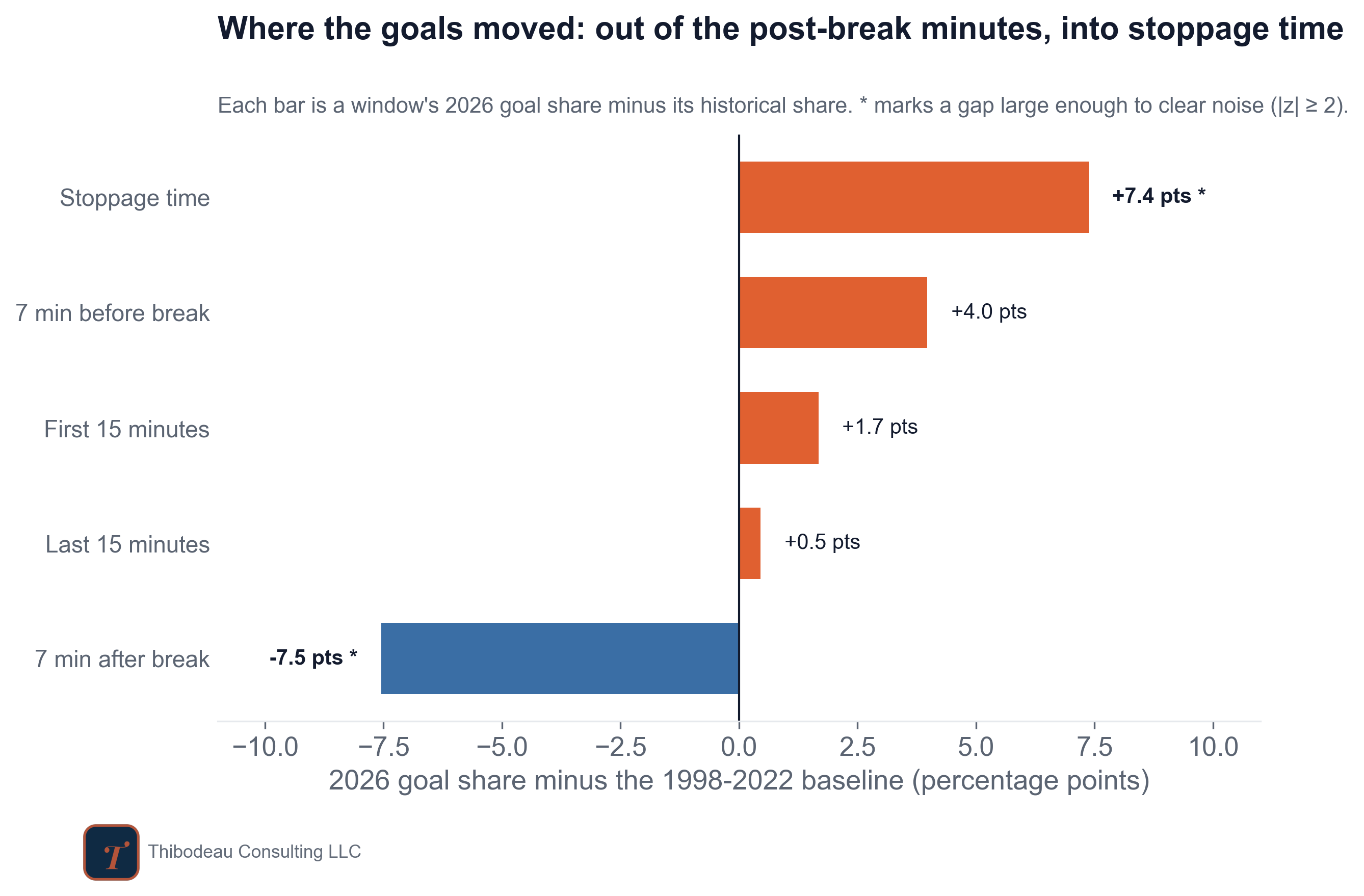
This does not prove the water breaks caused those goals. Nothing in this tournament gives us that clean a control group, because every match has the breaks. Refereeing instructions, substitution patterns, late-game incentives, mismatches, and plain randomness can all push goals toward the end of halves too.
But the mechanism is hard to ignore. If you add scheduled pauses, you add recoverable minutes. If you add recoverable minutes to a tournament where goal difference matters and more teams are alive late, you create more meaningful soccer after the clock has already reached 45 or 90.
That is the most defensible water-break story. Not that players drink and immediately score. Not that the trailing team gets a magic reset. The break quiets the game for a moment, then stretches the half at the end, where the game is already at its most frantic.
Up next
Tomorrow we go back to the forecast board to talk about error analysis. Not just who is winning, but why: where the models keep missing, which kinds of teams they misread, and whether the market’s edge is coming from better information, better calibration, or just cleaner priors.
Today’s Scoreboard and Forecasts
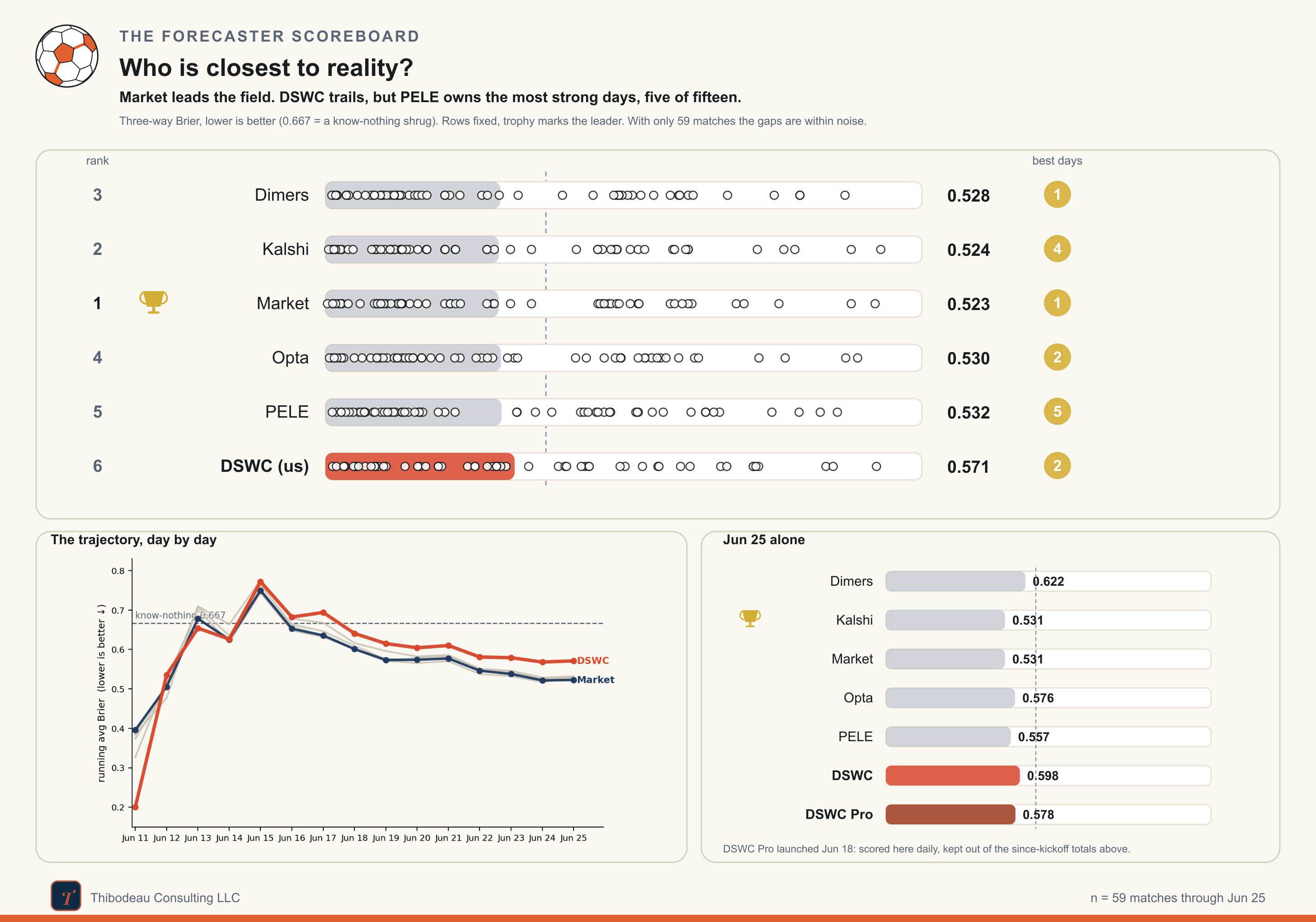
Day fifteen finally shook the top of the board. Dimers had been leading for a week, mostly by avoiding disaster while everyone else took turns getting nicked. Yesterday was the disaster: 0.622, its worst day of the tournament, and enough to hand first place to the market.
Classic had a mixed but revealing day. Its Germany skepticism was the best call on that upset, and its doubt of the U.S. helped when Türkiye won. But Japan-Sweden and Paraguay-Australia exposed the same old blind spot: it treated final-round state like ordinary team strength. DSWC Pro was towards the front, finishing at 0.578, ahead of Classic’s 0.598 and well ahead of Dimers, though still behind the market, which took the lead among forecasters for the first time in the cumulative standings.
Through 59 matches, the market leads at 0.523, Kalshi is basically tied at 0.524, Dimers drops to third at 0.528, then Opta at 0.530 and PELE at 0.532. DSWC Classic remains sixth at 0.571.
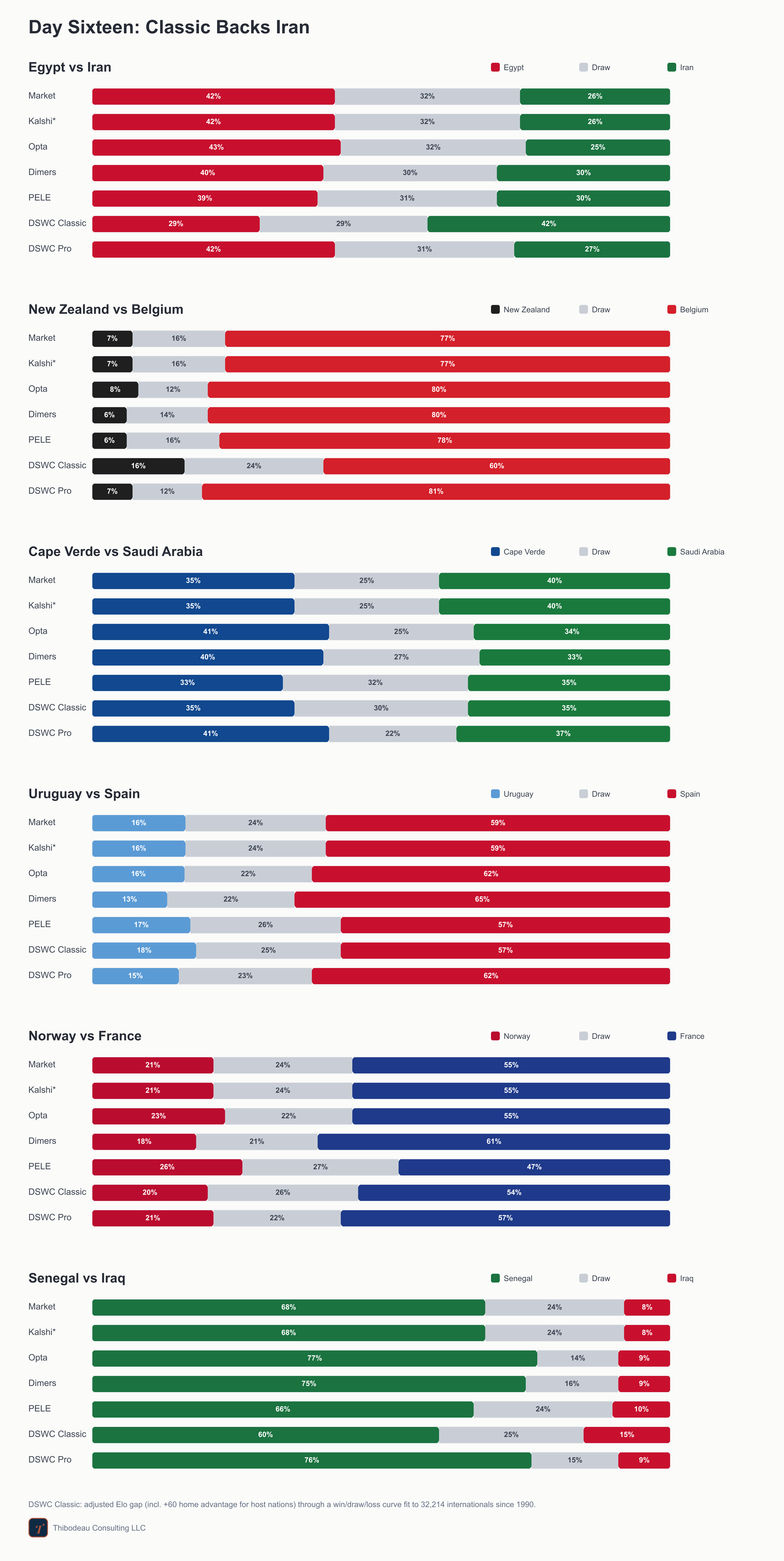
Today’s forecast card is mostly consensus with one familiar exception. The public models and the market see France and Spain as solid favorites in the two marquee games, Belgium as the clearest favorite on the board, and Senegal as the clean pick against Iraq. Cape Verde-Saudi Arabia is the toss-up, with the market leaning slightly Saudi while Opta, Dimers, and Pro shade toward Cape Verde.
The interesting split is Classic. It is closer to the field than usual in Norway-France and Uruguay-Spain, but it backs Iran outright against Egypt, 42 percent to 29, where everyone else has Egypt slightly ahead. It is also cooler on Belgium and Senegal than the public forecasters. That makes Group G the cleanest model test of the day: the board sees Egypt and Belgium as the safer side of the table, while Classic still wants to believe Iran are live.
I really hope this is the first and last of the Water Break.
As a spectator, I find it disruptive.
If I wanted disruptions, I'd stick with watching American football.