Can the Host Bump Save a Marginal Team?
Automatic entry, protected seeding, familiar ground, and the small advantages that bend a World Cup path

One week in, the first lap is complete. With yesterday’s games, all 48 teams have now played once. The opening round of group matches is in the books, the twelve tables have their first real shape, and the tournament has started to sort itself into early strolls, early trouble, and open questions.
Today the second round begins, and the hosts get the stage back. Canada plays Qatar in Vancouver, trying to turn a nervous opening draw into control of Group B. Mexico plays South Korea in Guadalajara, a meeting of two sides that both won on opening day. Around them, Czechia-South Africa and Switzerland-Bosnia fill out a slate mostly built from Groups A and B. Which makes this a good day to talk about hosting: what it gives, what it does not, and how much of the advantage shows up in the numbers. But first, a quick recap.
Previously, at the World Cup
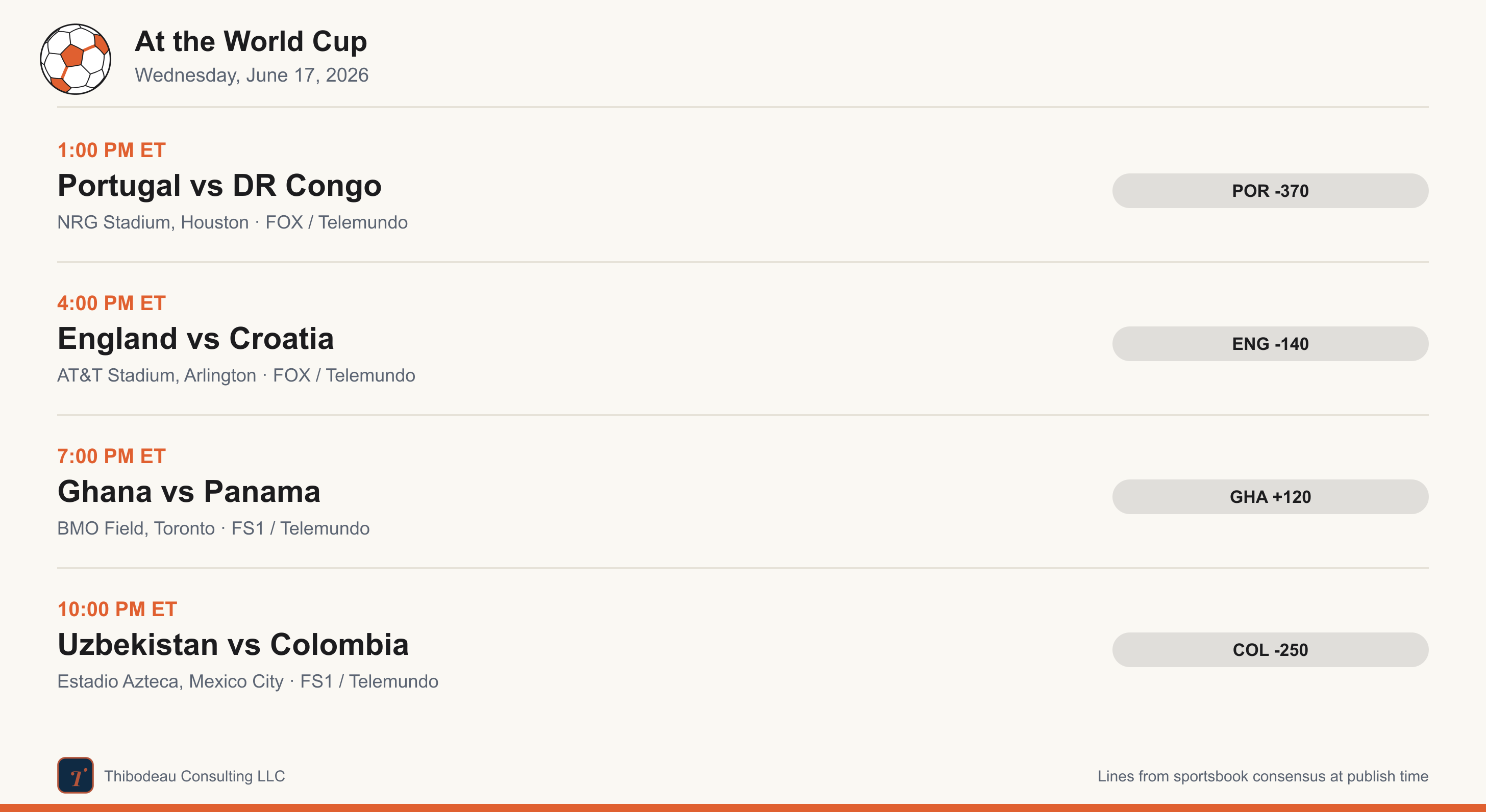
Yesterday gave us a little of everything. Colombia handled Uzbekistan 3-1, more or less to script. England and Croatia traded blows in the day’s true heavyweight game before England pulled away 4-2. Portugal, a heavy favorite, produced the headline stumble, failing to break through DR Congo in a scoreless draw nobody on the forecasting board saw coming. And in the smallest game on paper, the one we had circled, Ghana beat Panama 1-0. That one did not break our way, and the scoreboard at the bottom shows the bruise. More on that below.
Question 8 - What Are We Measuring When We Measure Hosting?
Yesterday we looked at confederation, a context feature that travels with a team into the tournament. It told us something about the soccer ecosystem around a team: who it usually plays, how it qualifies, and whether its rating lives on the same scale as everyone else’s. Hosting is another context feature, but it works differently. Confederation is the neighborhood you come from. Hosting is the house you get to play in.
That makes hosting a useful bridge between soccer and structure. A host is not necessarily better at soccer because it is hosting. But the tournament is arranged differently around it: automatic qualification, protected seeding, fixed group slots, familiar stadiums, shorter travel, and a crowd that turns neutral space into something closer to home. Hosting is not just atmosphere. It is a structural condition.
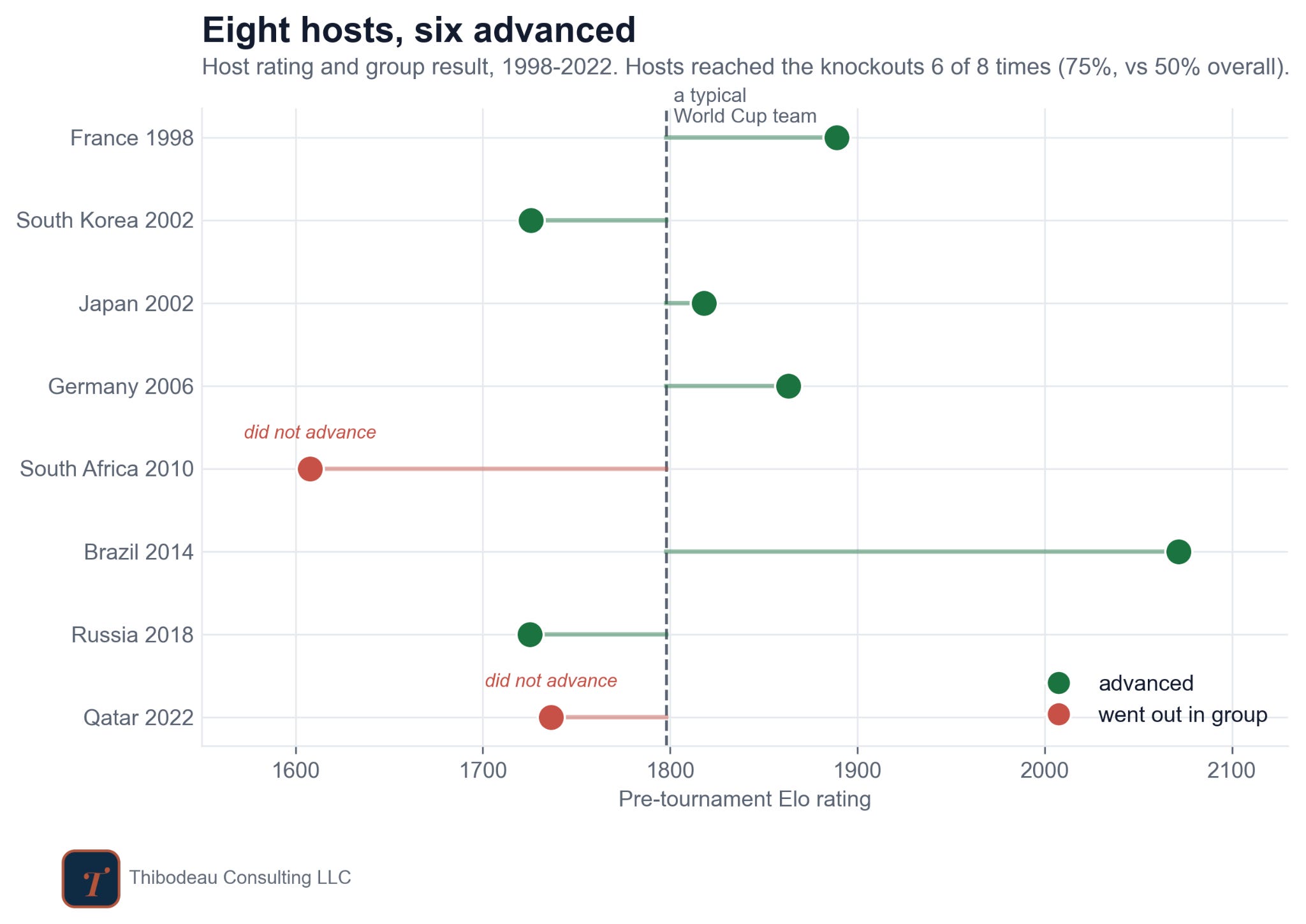
Between 1998 and 2022, six of eight host teams advanced from the group stage. That is 75 percent in an era when 50 percent of teams advanced. The interesting question is why. What exactly are we encoding when we add “host” to the model?
Hosts Skip Qualification
Hosting changes the tournament mechanically for the host team. The first advantage is simply getting in. Hosts qualify automatically, which means they skip the two-year grind and the risk of missing the tournament entirely. Italy has won four World Cups and missed the last two. A host never has to sweat that.
Hosts Get a Softer Draw
The second advantage is the draw. Teams are sorted into pots by ranking, and each group takes one team from each pot. That means a Pot 1 team avoids the other Pot 1 teams in the group stage. Hosts are placed in Pot 1 automatically, regardless of where their ranking would have put them.
That seeding may be worth even more than automatic qualification. A non-host with Canada’s ranking could easily land in a group with a heavyweight. Canada, as a host, cannot. The advantage is not just a vaguely easier schedule. It is the specific removal of the hardest kind of opponent from the group-stage draw.
The Hosting Advantage Compounds
Then come the smaller advantages. The host does not have to travel across the world. The crowd is theirs. The training bases, weather, food, routines, and stadiums are familiar. Referees are human. Pressure can hurt, but the tournament is still built around you. None of those advantages guarantees anything by itself. Together, they can bend the margins.
Hosts Are Not Random
The last thing to keep in mind is that hosts are not assigned at random. World Cups tend to go to countries with infrastructure, money, political influence, large stadiums, at least some soccer credibility, and who have a generous working relationship with FIFA. France in 1998 was not carried to a title by vibes. Germany in 2006 was Germany. Brazil in 2014 was Brazil.
So the question is not simply, “do hosts do well?” Of course many do. The better question is whether hosts do better than their underlying team quality would predict. If hosting really matters, the host flag should capture an extra push: the part that remains after accounting for team quality.
So What Are We Measuring?
When we put “host” into the model, we are not measuring a soccer skill. We are encoding a structural condition: automatic entry, protected seeding, geography, familiarity, crowd support, and the strange fact that the tournament has been organized around you.
That is why hosting is the easiest context effect to believe and one of the hardest to deconstruct cleanly. It is partly soccer, partly logistics, partly tournament design, and partly selection bias. It may be worth a rating bump, but not an infinite one. It probably helps most near the margin: teams good enough to compete, not so dominant that they would advance anywhere. For Mexico, Canada, and the United States, that bump probably matters. For Spain, less so. For Qatar in 2022, it was not enough.
Up Next
Tomorrow we start putting the pieces together. Over the past week, we have looked at the ingredients one at a time: team quality, recent form, World Cup experience, absence, defending champions, confederation, and hosting. The next step is to build a model that lets those features compete in the same room, so we can ask which ones still matter once the others are accounted for. After that, we’ll spend a few days on the models themselves: how to score them, how to test alternatives, what a more competitive version might look like, and what the strange first week of this tournament is already teaching us.
Today’s Scorecard & Forecasts
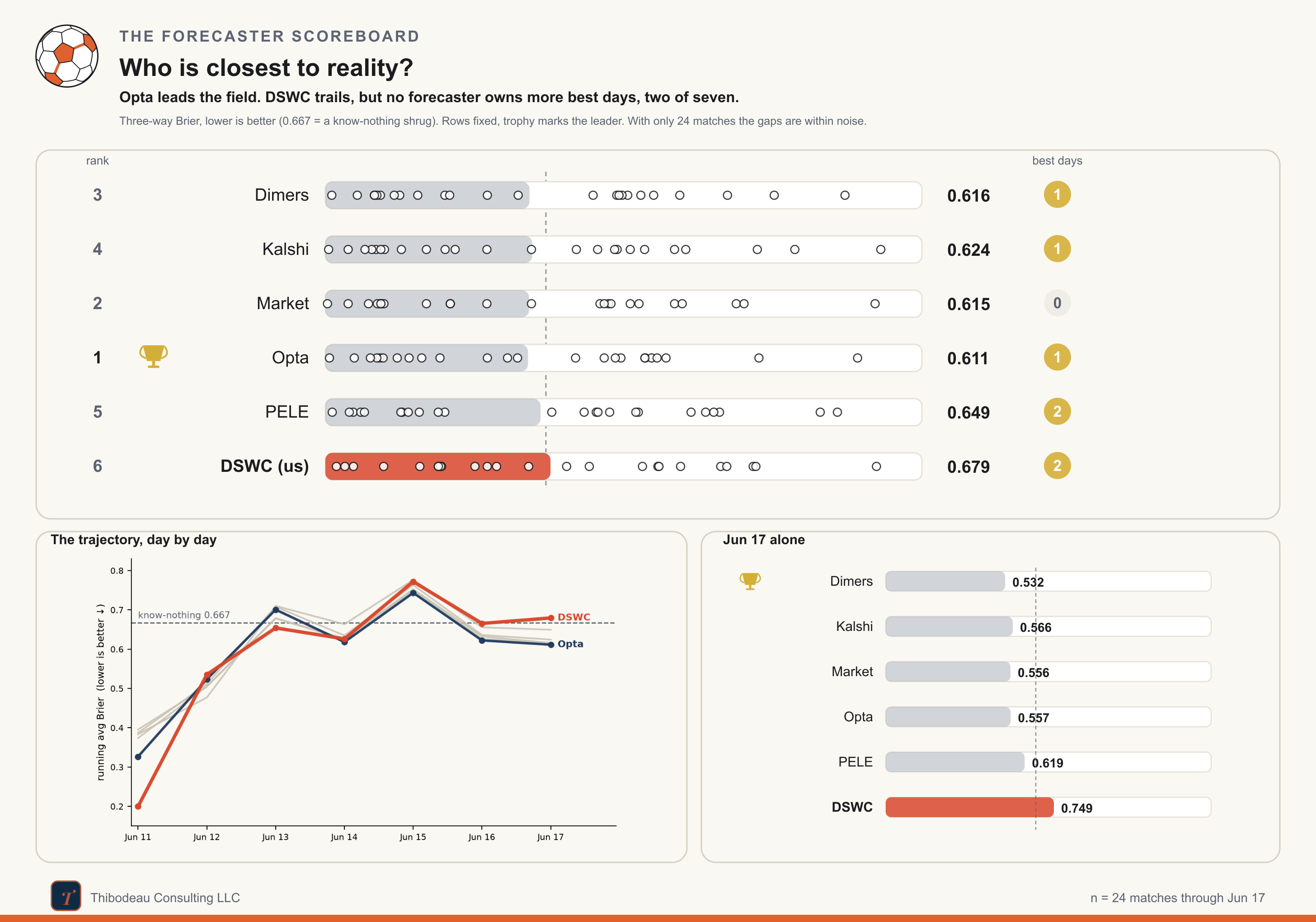
Yesterday was rough on us. Ghana-Panama was the most painful kind of miss: our model was the hardest lean on Panama, and Ghana won 1-0 on a Caleb Yirenkyi goal in the fifth minute of second-half stoppage time. By the spreadsheet, Portugal-DR Congo hurt even more.
In turn, DSWC had the worst day on the board, with a daily Brier of 0.749. Through 24 matches, Opta leads at 0.611, just ahead of the market at 0.615 and Dimers at 0.616. Kalshi sits at 0.624, PELE at 0.649, and DSWC trails at 0.679. Lower is better, and the know-nothing line is 0.667, which means our model has slipped just below the shrug. The consolation prize, if there is one, is volatility: DSWC has been the best forecaster on 2 of the 7 days so far, tied for best with PELE. The problem is that the bad days have been louder than the good ones.
This is a good place for a reminder. The DSWC model on the board so far is Version 1: deliberately simple, transparent, and pedagogical. It knows ratings and a home-field bump, and that’s mostly it. That was the point. It lets us see what a clean results-only model can and cannot do.
But starting now I’m adding a second forecast: DSWC Pro. Pro has a different job. Classic is built to teach; Pro is built to compete. I won’t publish the full recipe, but the motivation is straightforward: combine the wisdom of the field with what we’ve learned so far about this tournament and the places where a stripped-down ratings model misses useful information.
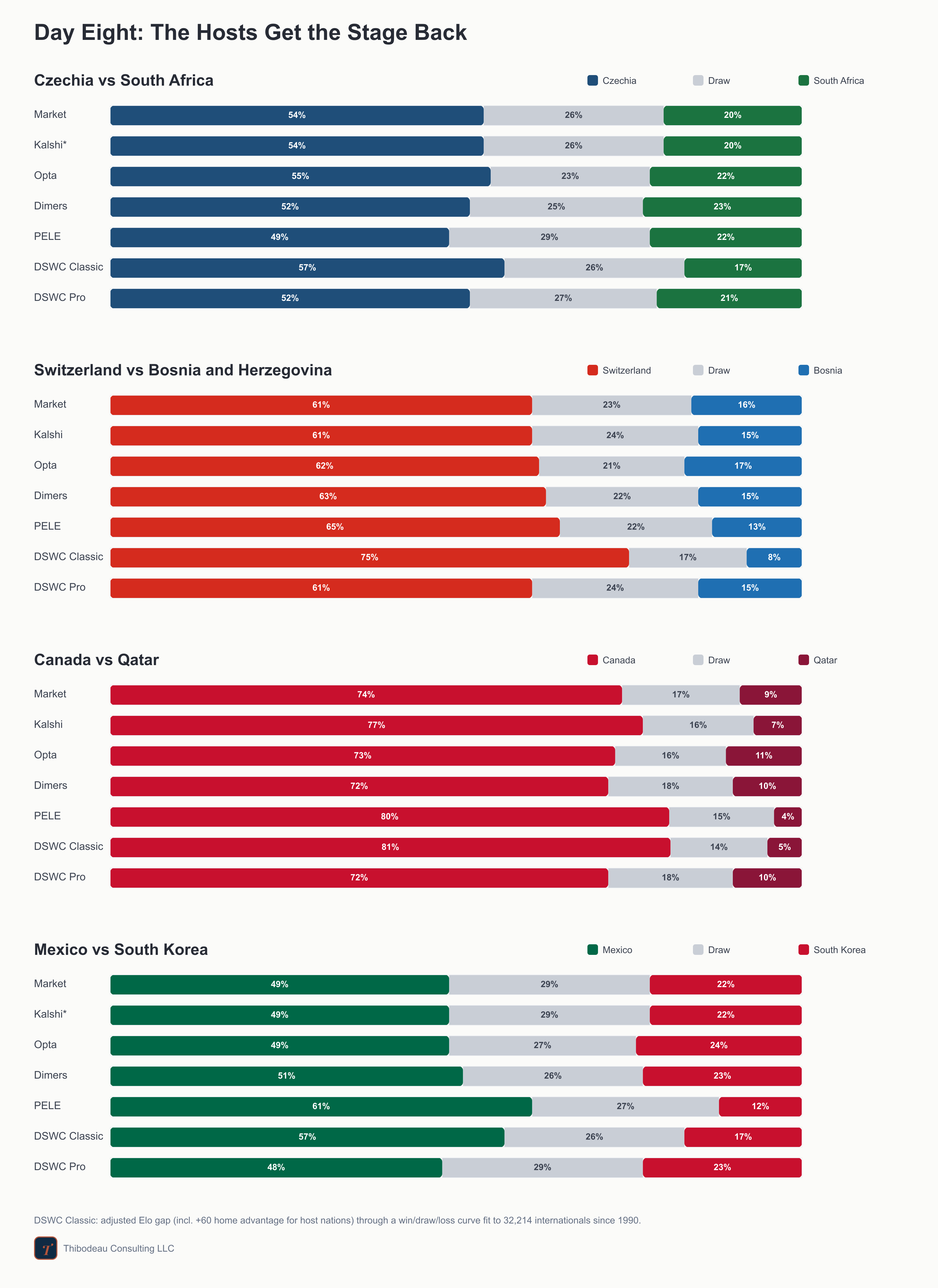
Today’s slate puts the host bump directly on trial. Canada and Mexico are both at home, and V1 is more willing than the market to believe in the advantage. Canada is the cleanest case: the market has Canada at 74 percent over Qatar, while V1 puts them at 81. Mexico-South Korea is tighter, but the same pattern holds: the market has Mexico at 49 percent, V1 at 57.
The non-host games are a mixed bag. Czechia is favored over South Africa across the board, with V1 a little higher than most at 57 percent. The biggest disagreement is Switzerland-Bosnia: the market has Switzerland at 61, while V1 jumps to 75. That is not a hosting story, just a rating story. But the day’s theme is clear enough. If the host bump is real, this is the kind of slate where it should show up. If Canada or Mexico stumble, the model’s thumb on the scale will be visible in the receipt.